
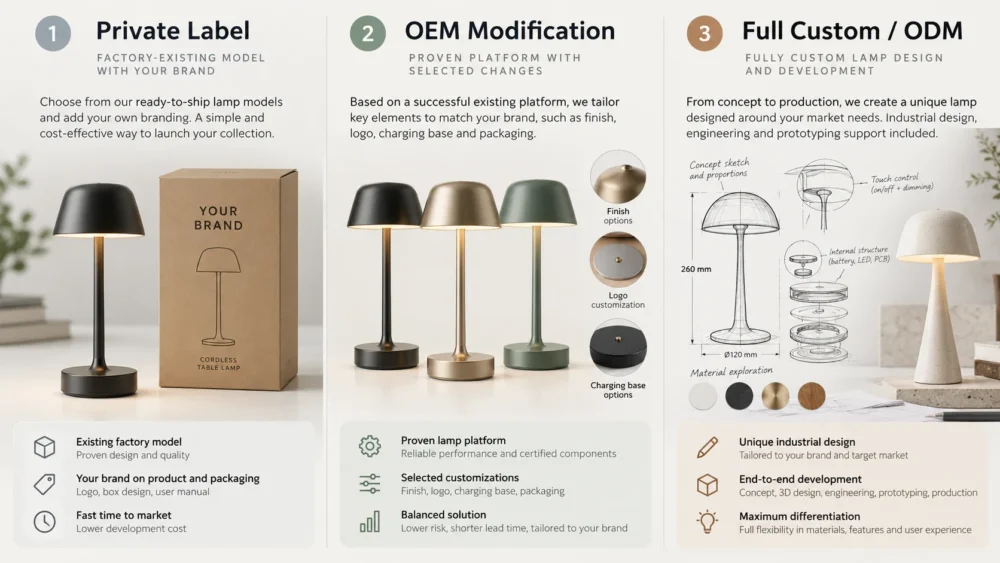
For brands adding a rechargeable SKU, private label table lamps do not need to begin with a new mold.
Define the buyer, setting, price position, and reason to choose it. Then select one of three routes: brand an existing model, modify a proven platform, or develop a new product. Most brands can start with rechargeable cordless table lamps and invest only in differences customers will notice.
Private Label vs OEM vs ODM Table Lamps: Which Route Are You Actually Buying?
Supplier terminology varies. Compare projects by what already exists, what must change, and what you need to own or control after development.
| Development route | What changes | Commercial impact to confirm |
|---|---|---|
| Existing model branding | Logo, labels, manual, box, and options already supported by the model | MOQ by model, color, and packaging; whether the same lamp remains available to other brands |
| Platform modification | Finish, selected materials, shade, light settings, controls, battery, or charging configuration | Extra samples or testing, per-variant MOQ, revised drawings and bill of materials, any new tooling |
| Fully custom development | New form, structure, mechanism, electronics, and packaging | Design and tooling cost, development schedule, tooling ownership, exclusivity, and rights to drawings or source files |
An “OEM” project at one factory may be called “ODM” by another. The useful question is not which label appears on the quotation. Ask what remains standard, what creates a new revision, and who owns any new tooling or design output. Choose full custom LED lamp development only when an existing structure cannot deliver the feature or silhouette that defines the product.
Settle those terms before approving tooling or paying for development work.
How Do You Choose an Existing Rechargeable Lamp for a New SKU?
Choose the base model by the parts that are hardest to change: proportions, stability, light distribution, controls, charging interface, and internal space. A new finish cannot rescue the wrong structure.
Channel changes the decision. An Amazon SKU needs a use case that is easy to show and packaging suited to individual shipment. A DTC brand may give more weight to silhouette, finish, unboxing, and collection fit. Importers and wholesalers usually need broader appeal, replenishment, and a platform that can support several colors or regional packs.
Write the position in one sentence before requesting samples. “A compact warm-light bedside lamp for small apartments” can guide a decision; “a modern rechargeable lamp” cannot. Material is part of that position: an aluminum or plastic table lamp body changes weight, finish options, perceived value, and packing needs.
For a concrete example. One aluminum-and-acrylic platform combines touch dimming, 2200–3000 K light, a 2600 mAh or customized battery configuration, and multiple finish options. A brand can keep the housing and charging interface while developing its own color, logo, packaging, and assortment. Changing the battery layout, charging system, or optical structure would move the project into a deeper platform modification.
What Can You Customize on Private Label Lamps?
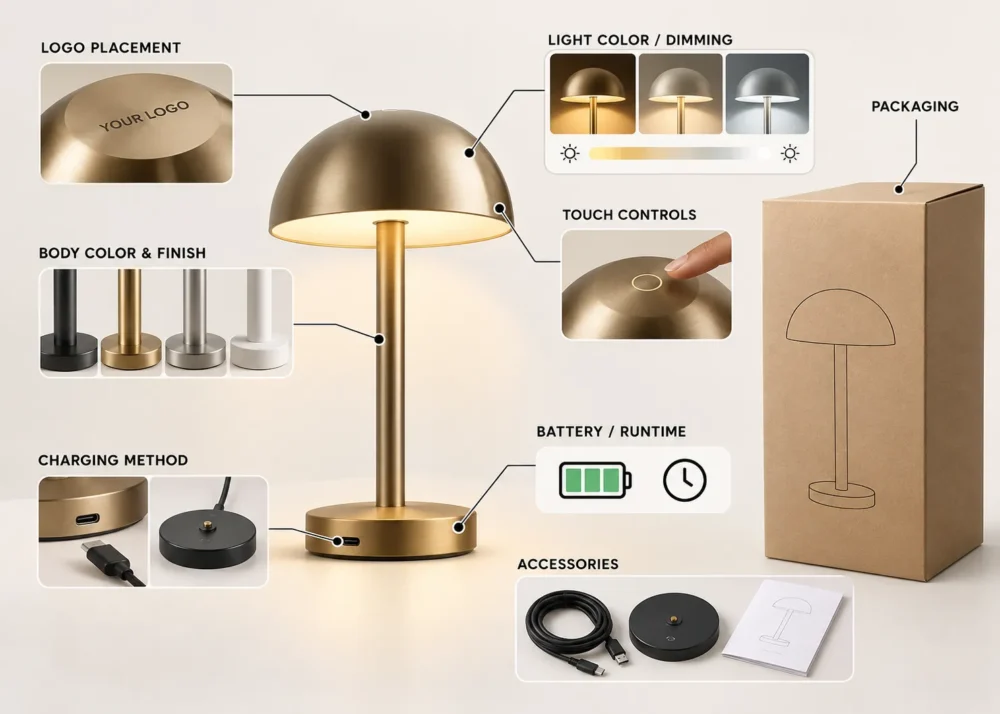
The visible change is only half the decision. Every request should be classified by how it is made and what it may change elsewhere in the product.
| Requested change | Typical implementation | What the brand should confirm |
|---|---|---|
| Logo, labels, and packaging | Engraving or printing, new artwork, insert, manual, and retail box | Logo sample, artwork revision, barcode accuracy, pack protection, packaging MOQ |
| Body color and finish | Powder coating, anodizing, plating, polishing, or another supported finish | Physical color sample, batch tolerance, MOQ per finish, added sample steps |
| Shade or diffuser | Existing alternative part or newly developed optical component | Fit, light distribution, glare, visible hot spots, and whether new tooling is needed |
| LED, CCT, dimming, or touch sequence | LED-module, driver, control, or firmware change | Light output, input power, heat, control behavior, and test scope for the new configuration |
| Battery or charging method | Approved battery option, internal layout change, USB-C, contact dock, or multi-unit charger | Tested capacity, runtime conditions, charging behavior, internal fit, and document coverage |
| New body structure | New mechanical design and tooling | Engineering scope, tooling ownership, schedule, samples, and exclusivity terms |
This table prevents a common sourcing mistake: treating every change as equally simple. A new box and a new charging architecture do not belong in the same approval path.
Battery capacity is a good example. The number printed on a cell does not tell you how long the finished lamp will run. Ask for tested capacity and runtime on the configured sample, with brightness, CCT, charging method, and start/end conditions recorded. The deeper rechargeable table lamp battery-life guide explains why the same nominal capacity can produce different operating times.
Color ranges create another hidden decision. A quotation may state one total order quantity while production is governed by a minimum for each finish. Confirm the quantity split by color, the packaging version for each SKU, and whether mixed colors share the same hardware and electronics.
What Should You Prepare Before Contacting a Table Lamp Manufacturer?
A useful inquiry should bring back suitable models and a clear development route, not a generic catalog. Give every supplier the same brief, especially when comparing custom table lamp manufacturers in China.
- Buyer, use, and channel: Describe who will use the lamp, where it will sit, and whether it will sell through Amazon, DTC, retail, or wholesale.
- Destination market: State the countries, required labels, languages, and documents that the supplier must review.
- Reference and product position: Share a factory model, sketch, or reference image plus the planned price tier and customer-visible difference.
- Fixed requirements: List size limits, materials, light color, controls, charging method, runtime target, and the items that are only preferences.
- SKU plan: Give the expected first order, quantity by color or version, packaging variations, target cost range, and launch window.
- Approval method: State the samples, tests, artwork, inspection criteria, and files you expect before mass production.
This brief lets a factory say “available on the current platform,” “possible with evaluation,” or “requires new development” against each request. That answer is more useful than a catalogue followed by one total price.
How Does a Private Label Lamp Move From Sample to Production?
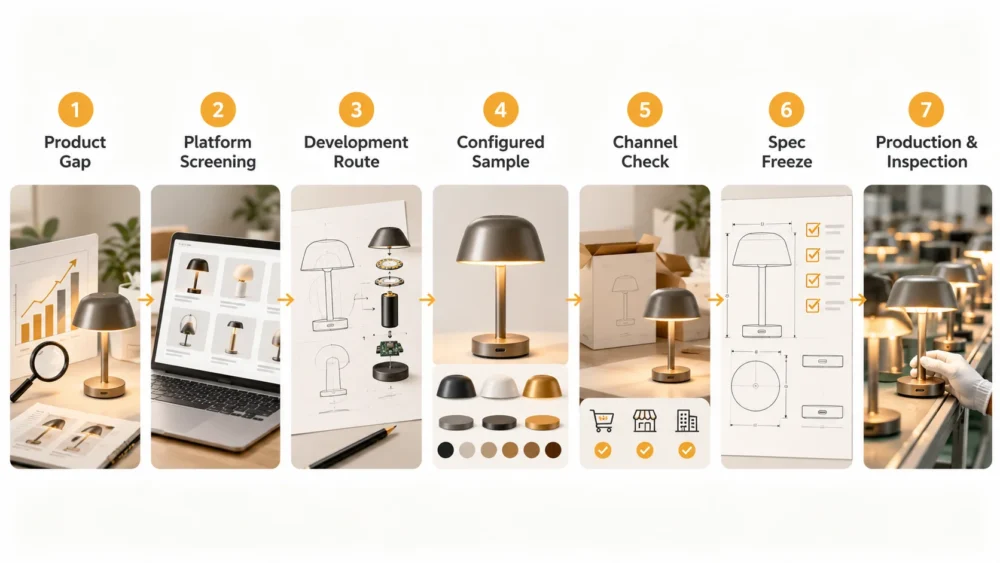
The process should close decisions, not create more email threads. A practical sequence is: brief and platform screening → scope and quotation → configured sample → channel review → specification freeze → production and inspection.
The configured sample is the turning point. Review it as the customer will receive it, including controls, light appearance, charging, accessories, labels, and packaging fit. If the product is difficult to explain at this stage, another listing bullet will not fix it.
After approval, connect the physical sample to one specification, bill of materials, artwork set, packaging layout, inspection checklist, and revision number. Comments scattered across messages are not a production standard. If a component changes later, the supplier should identify the affected function, test, and document before production continues.
What Is Specific to Rechargeable Table Lamps Before Mass Production?
Two checks deserve more attention than another generic quality checklist.
- Battery and charging must be tested as one system. Record the battery specification, charging hardware, indicator behavior, charge time, and runtime at an agreed light setting. Confirm that the production bill of materials uses the same battery and charging components as the approved sample.
- Optical changes must be judged on the illuminated lamp. A different shade, diffuser, LED layout, or internal distance can change brightness distribution, glare, hot spots, and the apparent color of the light. Compare the revised sample with the approved reference in the same room and at the same settings.
The same principle applies to reports and declarations. Ask the supplier to map each required file to the exact model and configuration. A document for the original lamp may need review after changes to the battery, driver, LED module, charger, or structure.
How Can You Start a Private Label Table Lamp Project?
Send a brief with your target market, sales channel, reference images, expected quantity, target price position, and the changes that matter most. Finished packaging artwork can come later.
iLEDGlow supports flexible MOQ and scalable production for private label lamp projects. Brands can begin with a smaller order for market testing, then increase production as demand becomes clearer. The workable MOQ still depends on the selected model, color split, packaging, and customization depth.
Send iLEDGlow your table lamp brief to compare existing-model branding, platform modification, and fully custom development against the SKU you want to launch.