
Any guide that hands you one number for this is guessing. Two identical racks need different tube counts the moment the crop changes — lettuce wants roughly three times the daily light a seedling tray wants. Here is the arithmetic instead, worked through on three real rack layouts.
The count falls out of four things you can measure or look up in an afternoon: the lit area of the shelf, your crop’s daily light target, the tube’s photon output, and how much of that output lands on the plants. None of them is watts.
Measure the lit strip first, not the rack
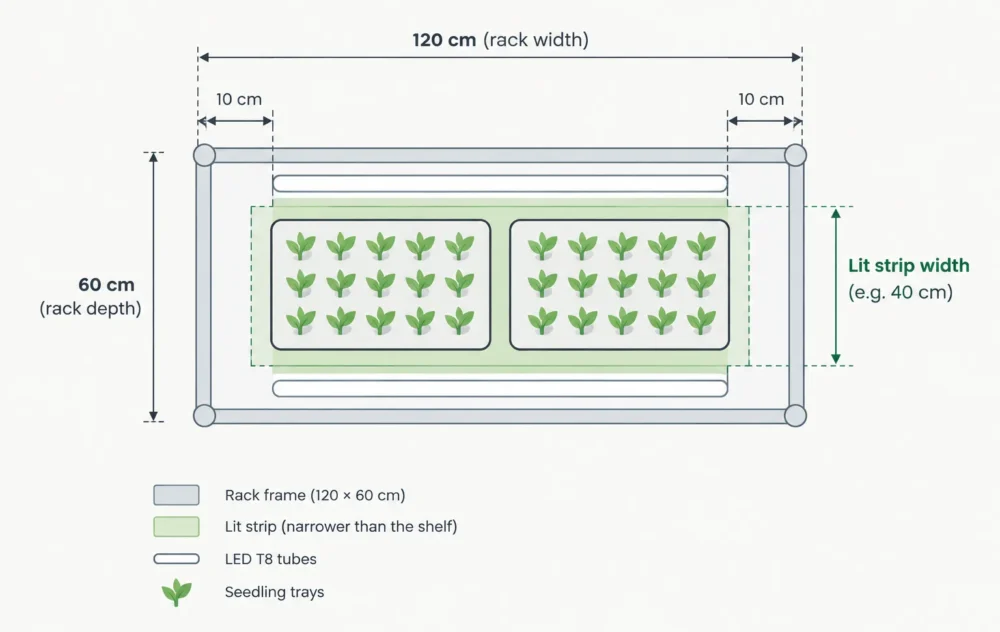
A 120 cm wide rack with 60 cm deep tiers does not give you 0.72 m² of growing area. It gives you whatever strip your tubes can actually cover, and on most racks that is narrower than the shelf.
Write down four numbers per tier:
- Tier length and depth, then the area your trays really occupy — they rarely fill a tier edge to edge
- Tray count and orientation — two 51 cm trays end to end is a different problem from three 25 cm trays side by side
- Usable hang height — on a four-tier rack with 50 cm between levels, maybe 25–30 cm once you allow for plant height. Each wattage has its own ideal hang distance, and it has to fit in that gap
- Crop and stage
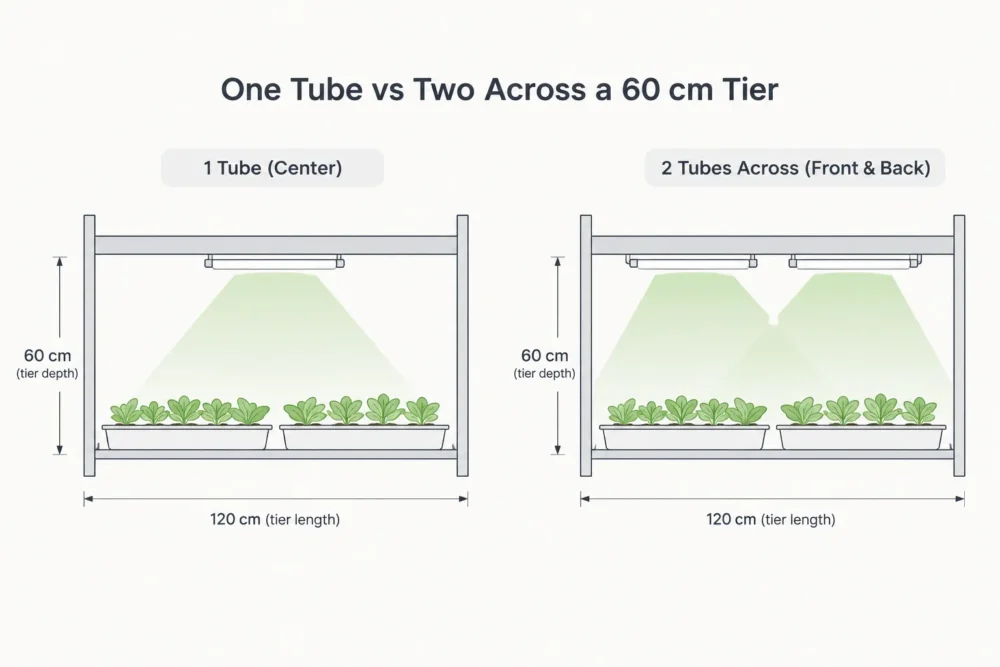
Tubes are linear, so the depth decides your layout, not the length. Light falls off fastest across the short axis. Put one tube down the middle of a 60 cm tier and the front and back rows come up short.
Set a daily light target for the crop
Seedlings want 5–10 mol/m²/day. Lettuce wants 12–17. Tomatoes want 20–30. Those come from Virginia Tech’s extension service, which publishes recommended daily light integral ranges by crop.
Daily light integral (DLI) is the total photosynthetic light a plant gets in 24 hours. Plan around it because it folds intensity and photoperiod into one figure. A weak light run long and a strong light run short can land on the same DLI.
| Crop | Recommended DLI (mol/m²/day) |
|---|---|
| Seedlings | 5–10 |
| Cuttings | 5–10 |
| Microgreens | 9–12 |
| Lettuce | 12–17 |
| Spinach | 14–20 |
| Basil | 15–25 |
| Tomato | 20–30 |
Ignore wattage and lumens here. Virginia Tech’s guide is blunt: candela, lumen, foot-candle, lux and watt are not recommended units for plant light — they describe how a light looks to human eyes or how much energy it draws, not how many photons reach a leaf. Ordinary LED bulbs light a room beautifully and still leave a shelf of seedlings short. Nothing is wrong with the bulbs; they were never specified in photons.
PPFD (µmol/m²/s) = DLI ÷ (photoperiod hours × 0.0036)
Lettuce targeting DLI 14 over 16 hours needs about 243 µmol/m²/s at the canopy. The same crop on 20 hours needs 194, a fifth less from the same tubes. How long the lights run moves that number as much as the fixture does.
Turn tube output into a tube count
Our 150 cm, 30 W T8 tube measured 69.909 µmol/s of PPF at 2.2779 µmol/J in its test report. That single figure converts a light target into a tube count. The whole calculation on a 1.5 m × 0.6 m lettuce tier:
- Lit area: 1.5 × 0.6 = 0.9 m²
- Photons needed at the canopy: 243 µmol/m²/s × 0.9 m² = 219 µmol/s
- Photons the tubes must emit: 219 ÷ 0.8 = 274 µmol/s
- Tubes required: 274 ÷ 69.909 = 3.9, so four tubes
Step 3 is the one people skip, and it is where most estimates go wrong. Not every photon a tube emits reaches a plant — some leave sideways, some bounce off the tier above. On an open rack with no reflector, roughly 80% of output lands in the canopy strip. Fit reflectors or run tubes close together and it climbs. Treat this first pass as an upper bound.
How many lights for a 10 × 10 ft grow room?
Ten by ten feet is 9.3 m² of canopy per layer, so lettuce at DLI 14 takes roughly 40 of the 150 cm tubes per layer. Stack four layers and you need 40 tubes per layer, not 40 for the room. Each layer is its own lighting problem.
How many plants can I grow with a 100W LED light?
A 100 W fixture says nothing about plant count until you know its efficacy and footprint. At 2.2–2.3 µmol/J that is 220–230 µmol/s of PPF; spread across the same 0.9 m² lettuce tier, it lands at roughly 196–204 µmol/m²/s, or DLI 11.3 to 11.8 on 16 hours, just under the 12–17 lettuce band. Plant count is the wrong unit anyway. That 0.9 m² holds two plants spaced wide or two hundred microgreens. What limits the light is square metres of canopy, so count trays, not plants.
Lay the tubes so the edges aren’t dark
Run tubes along the long axis of the tier and space them across the depth. A 120 cm tube over a 120 cm tier covers the length; the depth is where you have to think.
One tube centred on a 60 cm deep tier lights the middle 25 cm and leaves the front and back rows guessing; two tubes at roughly one-third and two-thirds of the depth even it out. Spacing runs into the same limit. If a tube’s useful spread is about 30 cm at your hang height, tubes 45 cm apart leave a visible dark band, and the outer 10–15 cm of each run sits dimmer than the middle.
Three rack layouts
The lettuce row uses the measured 150 cm figure. The other two use rated power × 2.2 µmol/J, the low end of our PPE range. Treat both as conservative until you pull the test report for that exact length.
| Shelf | Crop and target | Photoperiod | Tubes per tier | Hang height |
|---|---|---|---|---|
| 1.2 m × 0.3 m tier | Seedlings, DLI 9 | 16 h | 2 × 90 cm / 15 W | 20–35 cm |
| 1.2 m × 0.6 m tier | Microgreens, DLI 10 | 14 h | 3 × 120 cm / 32 W | 35–50 cm |
| 1.5 m × 0.6 m tier | Lettuce, DLI 14 | 16 h | 4 × 150 cm / 30 W | 35–50 cm |
Hang heights follow the wattage, not the crop. The seedling shelf lands at DLI 8.5 against a target of 9, so a third tube is optional; the microgreen row runs at 11.8 on 14 hours, near the top of its band. If the tube format itself is still open, T5 vs T8 covers the diameter trade-off before you fix lengths.
Do grow lights run up your electric bill?
Lighting is usually the largest single line on an indoor grow’s electricity bill, because it runs 14–18 hours a day while pumps and fans cycle on and off. Size it before you commit. Four lettuce tiers at four tubes each is 480 W — about 7.7 kWh a day on 16 hours, or roughly 230 kWh a month. Multiply that by your local tariff.
The lever on running cost is PPE, not wattage: a 2.7 µmol/J tube delivering the same PPF draws about 18% less power than a 2.2 µmol/J one.
What to confirm before you order
Send your supplier these rack parameters:
- Tier dimensions and count — length, depth, number of levels
- Crop, target DLI or PPFD, and photoperiod for each tier
- The PPF test report for the exact length you are buying. A line-level efficacy range is not your tube’s measured output, and this is the number the calculation rests on
- Input voltage, series limit, wet rating — 180–265 V, fewer than five tubes per run, sealed option for hydroponic channels
- MOQ, lead time, certification, warranty — OEM branding from 100–500 pcs, custom spectrum about two weeks, CE/RoHS/FCC, one year
The test report request is the one worth insisting on. A supplier who can hand you measured PPF at a stated input power has done the photometric work; one who can only quote wattage has not.
Frequently asked questions
How many grow lights do I need per shelf?
Divide your crop’s photons-per-second requirement by the tube’s PPF. A 1.2 m × 0.3 m seedling shelf takes two 90 cm tubes; a 1.5 m × 0.6 m lettuce tier takes four 150 cm tubes.
Can you overdo grow lights on a shelf?
Yes, and the ceiling is closer than most people expect. Past a point you pay for photons the plant cannot use. Match the crop’s DLI band rather than maximising output.
Can any LED light be used as a grow light?
It will emit light and the plant will use some of it. What you lose is usable intensity at rack distances, and any photon figure to plan with.
How far apart should T8 tubes be on a shelf?
Close enough that their spread overlaps. If a tube covers roughly 30 cm at your hang height, keep centres no more than 30 cm apart.
What is the best grow light for plants on shelves?
The one whose PPF you can look up and whose length matches your tier. On racks that means a linear tube rather than a panel — a panel throws a square footprint that wastes light past the shelf edge.