
The datasheet says “up to 8 hours.” The dinner service runs until 11. At around 9:30 on a busy Saturday, a cordless table lamp dies mid-meal. That gap — between the number on the box and the hours your venue actually needs — is the real story of rechargeable lamp battery life.
Buyers usually ask the wrong question first. Not “how long can this lamp last?” but “how long does my venue need it to last?” Runtime is not a fixed number — it is operating hours, brightness habits, and battery capacity working together. Match the battery to the venue before you order, and a modest lamp can carry a full service. Skip the math, and even an expensive lamp can leave you short at peak hour.
This guide is written for restaurant, hotel, bar, and café buyers — the people who run lamp batteries through real shifts. You will learn how many hours to expect per charge, how brightness changes the number, and what to check in a datasheet before a bulk order. New to the category? The cordless table lamp range is a good place to start.
How Many Hours Does a Rechargeable Table Lamp Last?
The honest answer is: it depends. Two numbers decide it — how bright the lamp runs and how big the battery is.
For consumer rechargeable lamps, a common full-brightness range is roughly 4.5–8 hours per charge. Some run higher, some lower. The datasheet number is usually “up to” something — the ceiling measured at the dimmest practical setting, not what you get at the brightness your guests actually see.
For commercial lamps, the range widens. iLEDGlow’s cordless range lists 8–40 hours across its models. That is a span covering different batteries and brightness levels, not a promise that every lamp runs 40 hours. A 2000mAh lamp typically runs about 6–8 hours. A 2600mAh lamp can stretch to 10–24 hours, depending on how it is set.
| Battery capacity | Typical runtime | What it means |
|---|---|---|
| 2000–2600mAh | 6–8 hours | Standard models; covers a typical dinner service |
| 3600–5200mAh | 12–20 hours | High-capacity models; long shifts, 8h+ lobbies, multi-evening use |
| Full cordless range | Up to 40 hours | At the lowest brightness setting, not a single-lamp promise |
So when a supplier quotes “8 hours,” the first question is not whether the number is honest. It is: at what brightness, with what battery, and in what service?
How Brightness Affects Rechargeable Table Lamp Battery Life
Brightness is the biggest lever on runtime. A lamp run dimmed draws less power, so the same battery lasts longer — usually about double, sometimes more.
Dimming, in plain terms, means lowering the brightness instead of running full output all night. Many commercial lamps use “stepless” dimming, which lets you set any level you want, not just two or three fixed steps. In practice, one lamp can behave like several: a bright task light for the first seating, a soft glow for the last.
The effect is significant. One model runs about 6–8 hours in typical use; dimmed, models in the same range reach 10–24 hours. The industry points the same way: a popular consumer lamp gives 4.5–6 hours at full brightness and roughly 20–24 at its lowest setting. Another jumps from 9 hours at full power to about 28 at 30% brightness.
The takeaway: decide how you will actually run the lamps before you compare numbers. A bar that runs lamps dimmed for mood can carry the night on a modest battery. A restaurant that runs them bright through service needs the biggest battery in its range.
Can a Rechargeable Table Lamp Last a Full Dinner Service?
Do the dinner-service math. A typical evening: doors open at 6, last seating near 9:30, tables cleared around 11. That is roughly five hours the lamps must stay lit — with the busiest stretch, the peak between 8 and 9:30, often run at full brightness.
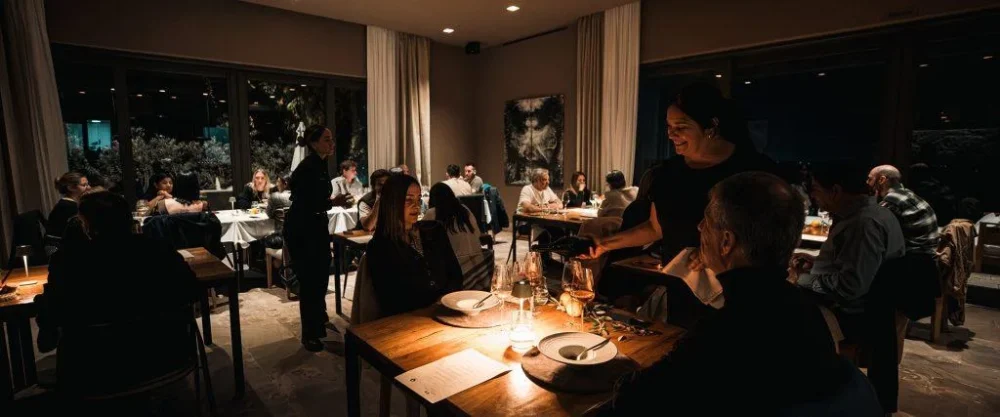
Now compare real numbers. A 2000mAh lamp at full brightness gives about 6–8 hours — close, with no margin for a long Saturday or a slow table. A 2600mAh lamp gives 10–24 hours, clearing a five-hour service with room to spare. Run lamps dimmed during quiet periods and brighten for the peak, and the same battery covers far more.
The cost of getting this wrong is not a dead lamp. It is a table of guests halfway through dessert, the light gone, a server hunting for a replacement while the mood dies — a problem that shows up in reviews, not just in hours.
Two levers fix it. Run dimmed for the quiet hours and full for the peak. Or spec a bigger battery so full brightness stops being a risk. Both are decisions you make at order time — not at 9:30 on a Saturday.
Rechargeable Table Lamp Battery Life by Venue: Restaurant, Hotel, Outdoor
The runtime you need changes with the venue. Here is how the numbers line up for the three most common setups.
Restaurant dinner service
Roughly five hours of runtime with a bright peak. A 2000mAh lamp covers a standard service; a 2600mAh model adds headroom for long shifts, second seatings, and slow tables. Most operators pick the bigger battery for safety.
Hotel lobby and lounge
Lobbies run lamps from afternoon to late evening — often 8 hours or more. Brightness is usually low, set for atmosphere. Dimmed, a 2600mAh lamp covers a full evening without a mid-shift swap.
Outdoor patio
Patios run long stretches, especially in summer, and the lamps live outside. Weather-rated models are the practical choice. An IP54 (weather-resistant) aluminum cylinder lamp from the same range runs 10–24 hours on its 2600mAh battery — enough to clear a long summer evening and come back the next.
| Venue | Hours lamps must stay lit | Brightness habit | What usually works |
|---|---|---|---|
| Restaurant dinner service | ~5 hours | Full at peak, dimmed otherwise | 2600mAh (2000mAh covers a standard service) |
| Hotel lobby / lounge | 8+ hours | Low, ambience | 2600mAh dimmed |
| Outdoor patio | 6+ hours, summer evenings | Medium, weather exposure | IP-rated model, 2600mAh |
Charging fits the same plan. Most USB-C lamps recharge in roughly 2–5 hours; a 2600mAh model from the same range takes about 3.5–5. With a charging base, staff can top lamps up between services or overnight and keep a spare set for busy weeks. The real question is not just how long a lamp lasts, but how often your crew recharges.
If you are still deciding whether cordless is the right call for your venue, the cordless vs wired comparison lays out that trade-off venue by venue.
What to Check in a Rechargeable Table Lamp Datasheet
A datasheet is a negotiation document, not a truth table. Here is what to actually look for.
- mAh is the battery size. Think of it like a fuel tank: a bigger number means more stored energy, not automatically more hours. Compare mAh only under the same brightness assumptions.
- Hours must come with a brightness level. If the sheet says “up to 8 hours,” ask: at full brightness, or dimmed? A number without a brightness condition is marketing, not a specification.
- Charge time and method. How long to full, whether USB-C or a charging base, and how that fits your staff’s rotation between services.
- Certifications. CE, RoHS, and FCC cover most markets.
- OEM options. On bulk orders, ask whether battery capacity can be matched to your service hours. This is where the venue math stops being theory: some suppliers, iLEDGlow included, customize capacity to fit a specific shift pattern — the OEM customization guide covers what to ask for.
Ask each supplier to put the runtime at your brightness level in writing, with the battery capacity. A supplier who answers specifically is usually worth working with; one who repeats “up to” is not.