Almost every new indoor grower asks this with the same worry in their voice: do I really need to buy a special grow light, or is the fluorescent shop light in my garage going to do the job? It’s a fair question, because fluorescents are cheap, they’re everywhere, and they’ve been growing plants since long before LED existed.
Here’s the plain answer: regular fluorescent lights grow a real range of plants well — and a different range poorly. Get the match right and you’ll save money and grow healthy plants. Match it wrong and you’ll wonder why your seedlings stretch or your tomatoes never flower. This guide tells you which is which.
Are Regular Fluorescent Lights Good for Plants?
Yes — for plants that don’t demand intense light. Fluorescent tubes are one of the oldest, best-documented tools in indoor gardening, and university extension services still recommend them today for two jobs in particular: starting seeds and growing low-light houseplants.
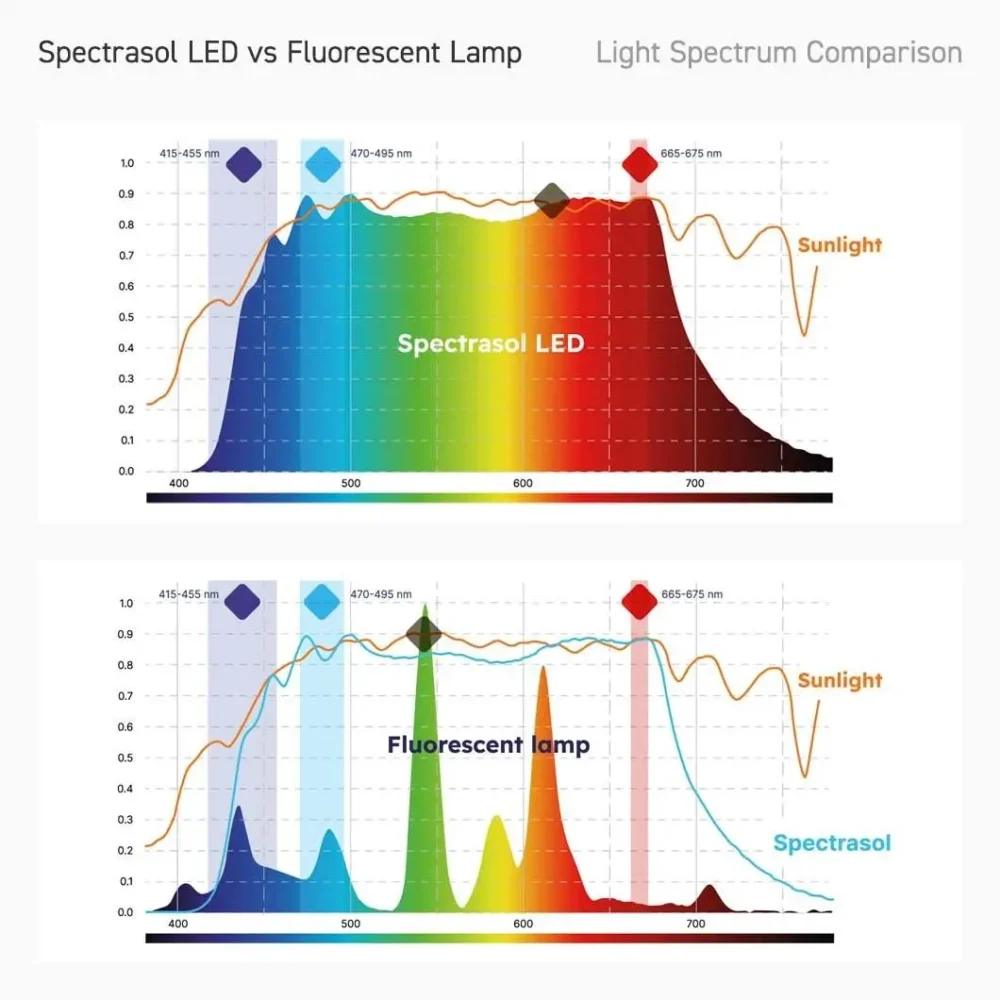
The reason is in the spectrum. Standard fluorescent tubes put out plenty of blue light, and blue light is what drives leafy, compact growth — strong roots, stocky stems, healthy foliage. That’s exactly what a seedling wants in its first weeks, and exactly what leafy greens and herbs need for their whole lives.
What fluorescents don’t have much of is deep red light, which is the wavelength plants lean on to set flowers and fruit. So the practical line to remember is:
The leaf-versus-fruit rule: grow leaves and stems (seedlings, lettuce, spinach, kale, herbs, microgreens) under fluorescent light and you’ll be happy. Try to force flowers and fruit (tomatoes, peppers, strawberries) with the same light and you’ll be fighting the physics the whole way.
What Grows Well Under Fluorescent Light — and What Doesn’t?
Run your plant against two questions and you’ll know in ten seconds whether your fluorescent tube is the right tool.
- What are you harvesting? Leaves, stems, and sprouts → fluorescent is genuinely good. Flowers or fruit → it will underperform.
- How much light does the plant want? Low- and medium-light plants are happy under a tube. High-light plants — tomatoes, peppers, eggplants, most flowering houseplants — will stretch, go pale, and disappoint.
Plants that do well under regular fluorescents:
- Seedlings — the classic use. Tomatoes and peppers are started under fluorescents every spring, then moved to stronger light later. Starting them is fine; flowering them isn’t.
- Leafy greens — lettuce, spinach, kale, arugula.
- Herbs — basil, mint, parsley, cilantro.
- Microgreens — they’re harvested young and small, so they barely need depth of light.
- Low-light houseplants — pothos, philodendron, Chinese evergreen.
Once you know a plant needs more than a tube can give, the fix isn’t a mystery — it’s a stronger light, which we get to below. And if you’re picking between tube sizes for a shelf, the T5 vs T8 grow light tubes comparison is worth a read before you buy.
Fluorescent vs LED Grow Lights: an Honest Comparison
Let’s put them side by side without the marketing. Both will grow plants; they differ in how far you can push them.
| Feature | Regular Fluorescent | LED Grow Light Tube |
|---|---|---|
| Best for | Seedlings, leafy greens, herbs, low-light plants | The same plants, plus fruiting crops and denser shelves |
| Spectrum | Blue-heavy; thin on deep red | Full spectrum, red/blue tuned per crop and stage |
| Heat | Runs warm; keep off young leaves | Cooler — LEDs on an aluminum housing shed heat fast |
| Lifespan | 7,000–15,000 hours, then dims | Roughly 20,000+ hours with less fade |
| Flicker | Yes (too fast to see, plants notice) | Flicker-free driver |
| Fixture extras | Needs a ballast | No ballast — runs on its own driver |
None of this makes fluorescents bad. They’re just a tool with a clear range. The reason most home growers eventually switch is that the range turns out to be narrower than they hoped — they want to ripen peppers, flower an orchid, or pack more onto one shelf, and the tube runs out.
How Close Should Fluorescent Lights Be to Plants?
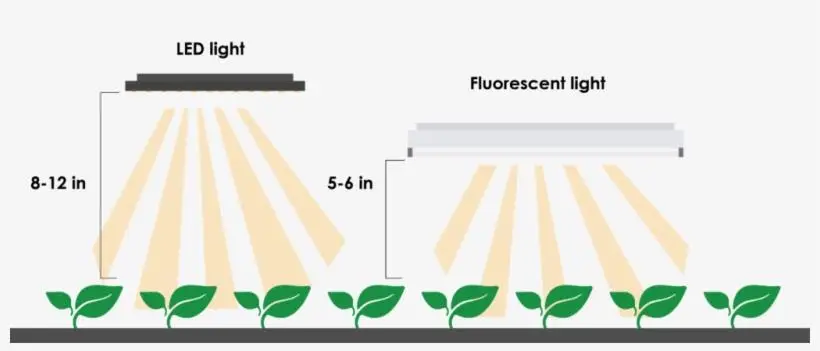
Because fluorescents are relatively gentle, you can run them much closer than you’d dare with a hot light — and you should, because light intensity falls off fast with distance.
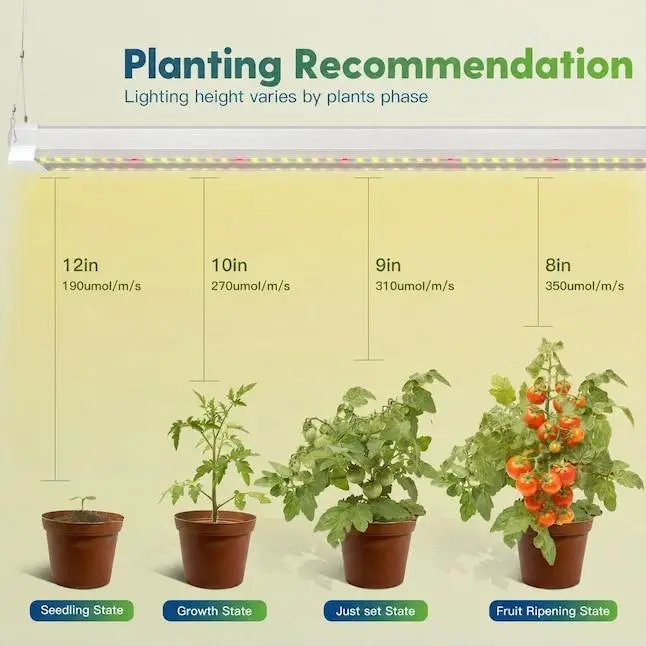
- Seedlings and young starts: keep the tube just 2.5–8 cm (1–3 in) above the leaves. Start low and raise it as they grow.
- Leafy greens and herbs: 15–30 cm (6–12 in) above the canopy works well.
- Houseplants: 15–30 cm is a good starting point; watch for how they respond.
Watch the plant rather than measuring perfectly. Seedlings that grow tall and skinny are reaching for light — move the tube closer. Leaves that look pale or bleached at the tips are getting too much — raise it. Fluorescent tubes also lose brightness at the ends, so overlap tubes slightly if you’re covering a wide shelf evenly.
Run times are straightforward too: 14–16 hours a day for seedlings and leafy greens, and 12–14 hours if the plants also get window light. A simple timer keeps it consistent, and consistency matters more than any single hour.
When Fluorescent Lights Stop Being Enough
There are a few honest signals that your fluorescent setup has hit its ceiling. If you recognize any of these, it’s not your fault — it’s the light running out of range:
- You want fruit. Tomatoes, peppers, or strawberries that flower but drop their blooms are crying out for deep-red light a tube can’t give.
- Leaves are pale and growth is slow even with the tube an inch away — the plant needs more intensity than the tube physically produces.
- Your tubes are old. Fluorescents fade with age (roughly 7,000–15,000 hours), and a dim tube quietly starves plants. If yours flicker or have dark rings at the ends, they’re past their prime.
- The shelf is packed. Dense microgreens or a full multi-tier rack need more light per square centimeter than a single tube spreads.
Here’s the thing worth knowing before you spend anything: fixing this doesn’t have to mean buying a whole new lighting system. The fixture holding your fluorescent tube is usually fine — it’s the tube itself that’s holding you back.
Upgrade Without Changing Your Fixture: Swap in LED Grow Light Tubes
This is the upgrade most articles never mention, because most articles are written by companies that want to sell you a complete new light. If your fluorescent fixture still works and fits standard tubes, you can usually keep the fixture and replace just the tube with an LED grow light tube of the same size.
Regular LED shop tubes will grow some plants, but an LED T8 grow light tube goes further: it adds the red and full-spectrum bands that fluorescents lack, runs cooler so you can hang it closer, and drops into the same slot you already have. You get the fruit-stage light, the shelf density, and the longevity — without ripping out a working fixture.
Two practical notes if you go this route. First, because LED tubes run on their own driver, they remove the fluorescent ballast from the equation entirely — one fewer thing to maintain and fail. Second, LED T8 tubes come in the same standard lengths (60, 90, and 120 cm), so matching your existing fixture is straightforward.
Keep the fluorescent for what it’s genuinely good at — a gentle nursery light for seeds and low-light plants costs almost nothing to run. Add an LED tube on the shelf where you want real results. It’s the most honest, budget-friendly way most home growers can grow more without throwing anything away.