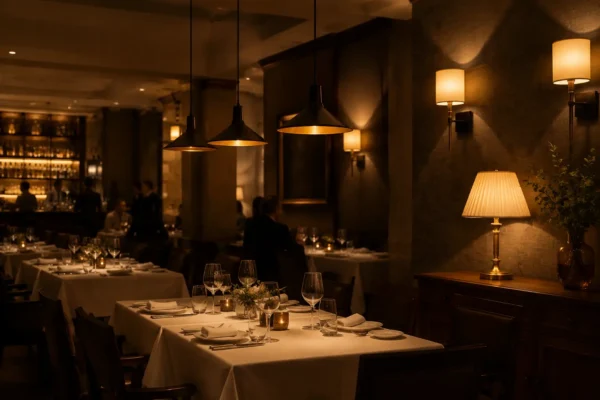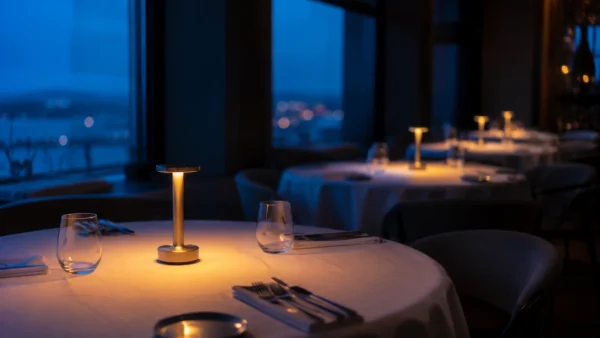

Choosing rechargeable table lamps for restaurants is easy until you think about the second night. The first night, the lamps are fresh out of the box, fully charged, glowing on every table. The second night you realize something nobody mentioned: all of them need power again, and someone has to make that happen.
Most buying guides cover the pretty side — warm light, nice materials, battery hours. Few talk about what happens after closing, when dozens of lamps need charging before the next shift. This is a checklist of six questions to ask before you order, written for restaurant owners, managers, and designers, and based on how commercial rechargeable lighting is typically built, spec’d, and sold.
1.Will a rechargeable table lamp stay lit through a full dinner service?
A dinner service usually runs four to five hours. A lamp that dies at 9:30 on a busy Saturday is worse than no lamp — it sits dark on the table, and someone has to deal with it mid-service.
Here’s the part datasheets tend to hide: runtime depends heavily on brightness. The “up to 24 hours” on a spec sheet is almost always measured at the dimmest setting. Run the same lamp at the brightness guests actually see, and the runtime drops.
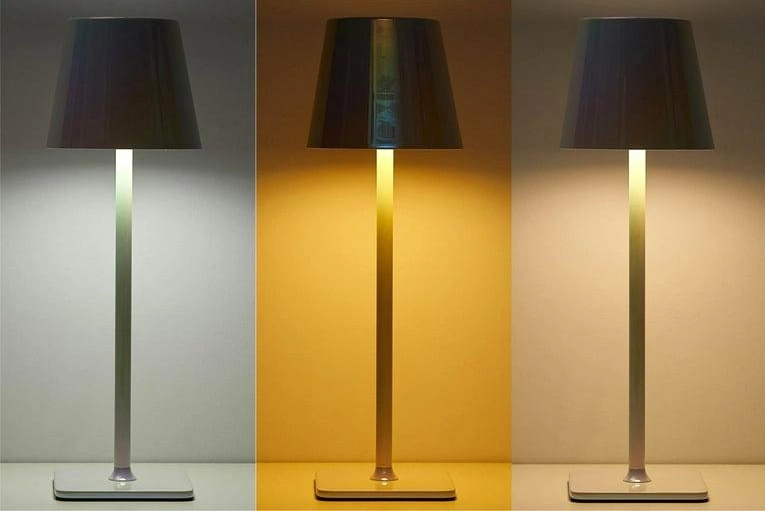
This gap between rated and real-world runtime isn’t specific to any one brand — it shows up across the category, because “up to X hours” is a marketing-friendly number measured under the most favorable conditions. A lamp rated 24 hours might realistically deliver 10–14 hours at the brightness a dinner table actually needs, depending on battery capacity and LED efficiency.
What to check: ask any supplier for runtime at medium brightness, not just the “up to” number, and ideally ask for that figure measured with a full battery at the end of its rated cycle life, not a brand-new cell. If you want the full breakdown of how hours translate across venues, our guide to rechargeable table lamp battery life goes through it in detail.
2. How do you charge multiple rechargeable table lamps?
Behind that technical question is a simpler one: who’s going to charge 40 lamps after closing? With USB-C charging, every lamp has a cable. Forty lamps, forty cables, and usually one or two outlets near the back of house. At closing time a staff member stands at the outlet, plugs lamps in one by one, and unplugs them in the morning. Do that seven nights a week.
It’s not a disaster — it’s time and wear. Charging multiple rechargeable table lamps is a workload decision as much as a product decision. The bigger your venue, the more it shapes staff routines, where charging happens, and how lamps are stored between services.
If you already run 20, 40, or more lamps, charging stops being a spec and becomes an operational issue — worth planning before you order.
3. Charging base vs USB-C: which charging method fits a restaurant?
Restaurant lamps typically charge one of three ways:
- USB-C cable per lamp — cheapest to buy, but every lamp needs its own cable and outlet. At closing, a staff member plugs in lamps one by one and unplugs them again in the morning. Multiply that by every lamp, every night.
- Contact charging base — the lamp is simply set down on a base and starts charging, no cable to line up. Setting a lamp down is one motion versus several for a cable; the trade-off is that contacts can collect dust or spilled liquid and occasionally need wiping.
- Multi-lamp charging station or trolley — one unit charges many lamps at once. It’s a bigger upfront purchase, but it tends to pay for itself once you’re managing dozens of lamps rather than a handful, since it removes the “one staff member babysitting an outlet strip” problem entirely.
None of these is objectively best — a small café with eight lamps may find cables perfectly manageable, while a 200-seat venue with 60 lamps will feel the difference in staff time within the first week. The right call depends more on headcount and volume than on any single spec.
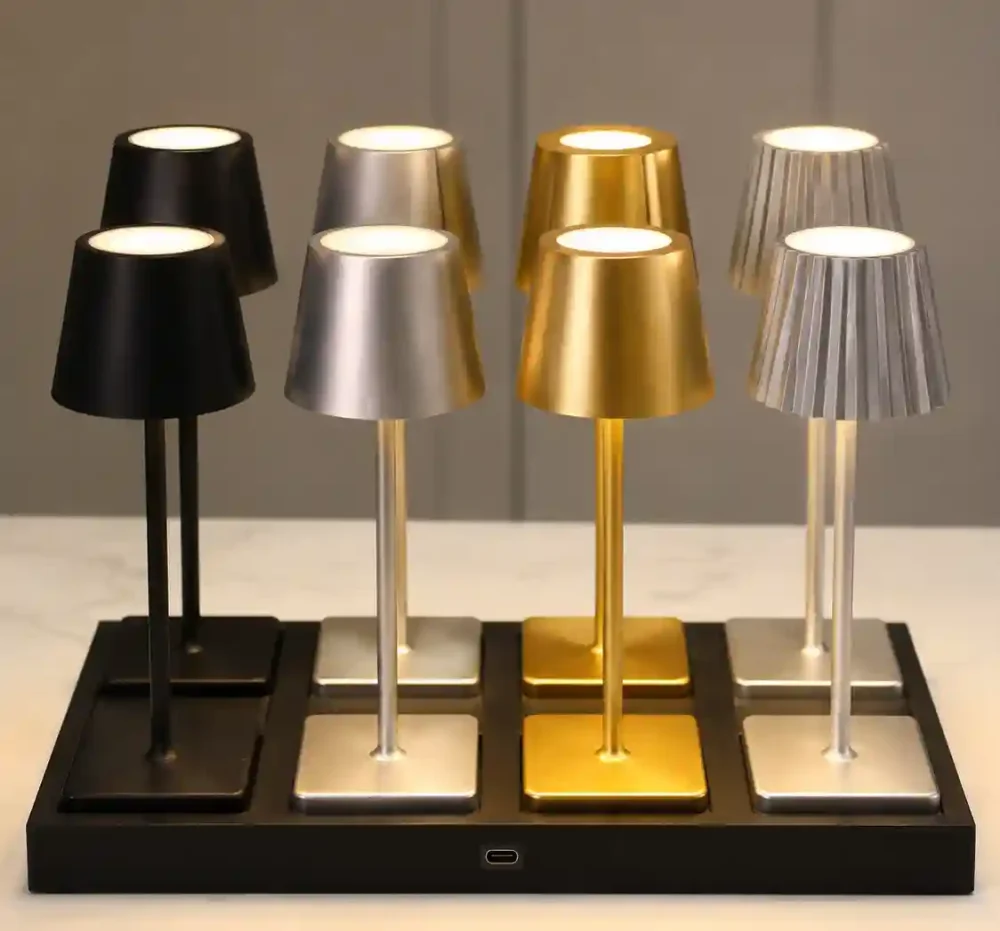
Contact-charging bases typically draw power over a low-voltage USB-C input, which is simpler and safer to wire up in bulk across many tables than running high-power outlets to each one.
What to ask: does the lamp come with a base (or charging slot) for every unit, or are bases sold separately? That answer often changes your total budget more than the price of the lamp itself.
4. Do the lamps need to survive spills and outdoor tables?
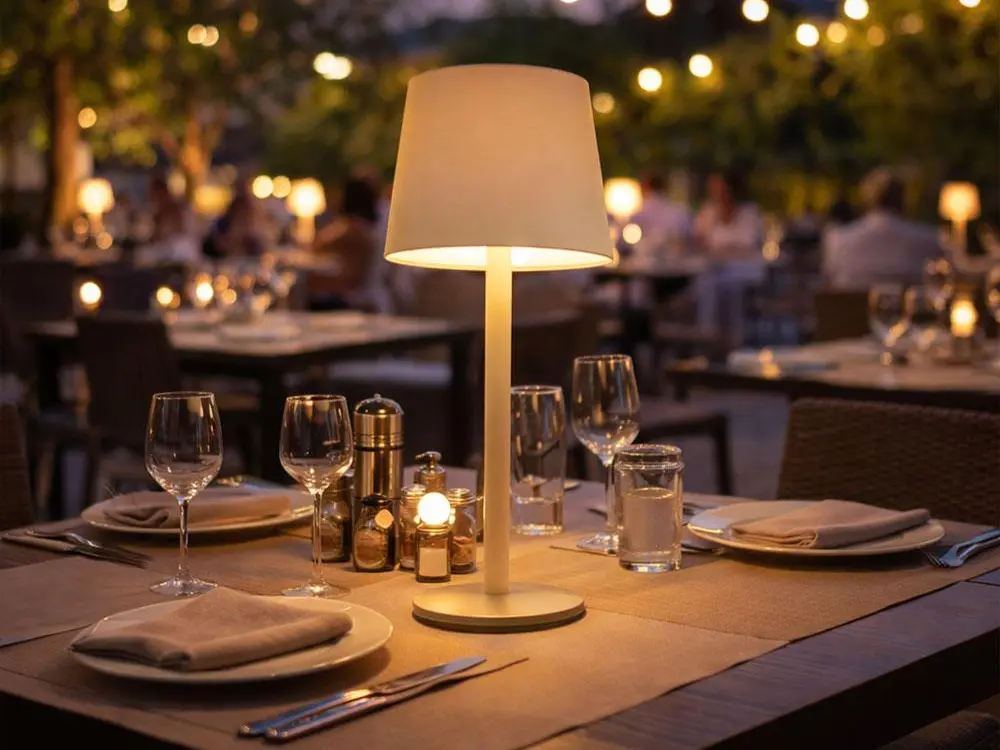
Restaurant lamps get knocked, wiped down, and occasionally splashed. If any of your tables sit on a patio or terrace, weather matters too.
IP ratings
IP ratings tell you how sealed a lamp is. IP54 means protection against dust and splashing water — often suitable for covered terraces and normal indoor spills. For open outdoor areas exposed to direct rain, look for IP65 and up. If your venue mixes both settings, our guide to IP54 vs IP65 outdoor table lamps breaks the ratings down by real dining scenario.
Material
Material matters too, though it’s less decisive than people assume. Aluminum bodies with acrylic or glass diffusers tend to offer good durability and heat dissipation, but construction and finish quality matter more than the raw material itself — a well-made plastic housing can outlast a poorly finished metal one.
Color temperature
Color temperature shapes how food and skin tones look under the light. Most restaurants run 2700K–3000K; cooler light tends to make food look clinical rather than appetizing. A lamp with a fixed high color temperature (5000K and up) may suit a bright, casual concept, but it’s rarely the right fit for a classic dinner-service atmosphere. If you’re unsure which fits your concept, see our guide to the best color temperature for restaurant lighting.
Quick reference:
| Setting | Recommended rating |
|---|---|
| Indoor only | IP rating matters less |
| Covered patio or terrace | IP54 is usually enough |
| Fully exposed outdoor area | Consider IP65 and up |
| Coastal location | Ask about corrosion resistance specifically, not just the IP number |
5. What happens when a battery eventually dies?
Every rechargeable battery fades. After a few years of daily charging, runtime shrinks, and eventually a lamp won’t hold a charge. That’s normal wear, not a defect — batteries are rated in charge cycles, and nightly restaurant use can put noticeably more cycles on a battery per year than typical home use.
The real question is what happens next: does the lamp become e-waste, or can you keep using it?
- If the cell is replaceable, you keep the lamp and the base and simply swap the battery.
- If it’s sealed inside, the whole unit is discarded and you buy another.
Before ordering, it’s worth asking a supplier — any supplier, including us — four things about the battery specifically:
- Is the battery replaceable, and can it be swapped without special tools?
- Which cell is used, and will spares realistically still be available in a few years?
- What cycle life does the supplier claim — and is that a lab figure or a real-world estimate?
- Does the warranty cover the battery specifically, and for how long, separate from the lamp body?
These answers affect what your lamp fleet costs over five years, not just on day one. For a venue buying dozens of lamps, that gap is often larger than the price difference between models up front.
Rechargeable table lamps are sold everywhere, but a lot of what’s on the market is repackaged consumer hardware rather than something built for commercial cycles. For a restaurant buying in quantity, a few questions tend to separate a manufacturer from a reseller:
- Can the battery capacity be matched to your service hours? A lamp built for a 3-hour lunch shift and one built for a 6-hour dinner-through-late-night shift shouldn’t necessarily use the same cell.
- Do lamps ship with charging bases included, or are bases a separate line item? Charging infrastructure changes your total order cost — worth confirming up front rather than after the invoice arrives.
- What certifications apply in your market? It’s worth asking any supplier to confirm in writing rather than taking a spec sheet at face value.
- What’s the minimum order quantity, and what does OEM/customization actually cover? Logo, finish, packaging, cable length — get it written down before you commit, regardless of who you buy from.
These four questions apply to any supplier you’re evaluating — they’re a reasonable baseline for separating a manufacturer that can support a commercial order from a reseller who’s just relisting consumer stock.
We’re iLEDGlow, a manufacturer in Dongguan, China, building cordless table lamps and charging bases since 2011. You can see the contact-charging models and their full specs on our cordless table lamps page.
Before You Order: A Quick Checklist
- Runtime confirmed at the brightness you’ll actually use — not just the “up to” number
- Charging method decided (cable, base, or station) and matched to your lamp count and staff routine
- One base or charging slot per lamp included, or priced separately
- IP rating matched to your indoor/outdoor mix
- Battery replaceable, spares available, and warranty covers the cell specifically
- Certifications confirmed for your specific market
- MOQ and OEM scope written down before ordering
Most guides end by telling you what to buy. This one ends where the real decisions start: the questions worth taking to a supplier. The best rechargeable table lamp for a restaurant is the one your staff can charge without thinking about it.
If you still deciding between the two types? Our comparison of cordless vs wired table lamps for restaurants covers that.