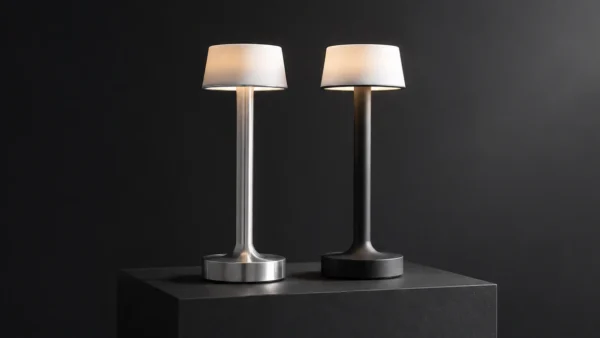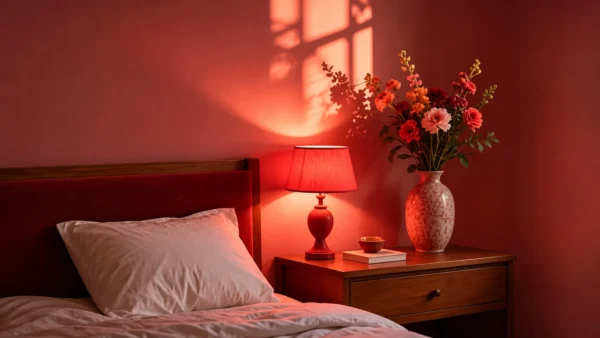
For a conventional shaded bedside lamp, start by comparing dimmable bulbs around 400–800 lumens. A focused clip-on directs light toward a smaller area, so check its brightness at the book rather than applying the same lumen range.
For lighting brands developing a circadian product line, plan for two tasks: clear reading and brief nighttime use. Amber is a practical starting point for bedtime reading; deep red is a separate option for finding things at night. Both need suitable brightness control.
How many lumens does a bedside reading lamp need?
Use lumens (lm) to compare total light output and lux (lx) to check how much light reaches the book.
A 400–800 lumen bulb can suit a shaded table lamp because its output spreads beyond the page. A directional lamp sends more light toward a smaller area. Its mounting distance and beam coverage matter as much as its total output.
The Energy Saving Trust’s home-lighting guide recommends local bedroom reading illumination of up to 400 lux. This is design guidance, not a minimum every reader must reach.
Small print, low-contrast paper and older readers can require more light than a large-print paperback. Select an adjustable range rather than one fixed reading level.
Three details change the reading requirement:
- Print size: small footnotes need more visibility than large body text.
- Paper and ink: pale gray type on cream paper has less contrast than black type on white paper.
- Page finish: glossy pages can reflect the lamp toward the eyes; change the angle before adding brightness.
| Intended use | Useful brightness reference | What to select |
|---|---|---|
| Reading with a shaded table lamp | Compare bulbs around 400–800 lm | Dimming plus a shade that directs useful light toward the book |
| Focused reading with a clip-on lamp | Check the page in lux; the home-lighting guide gives up to 400 lx as a local-reading reference | An adjustable head that covers both pages |
| Finding a glass of water at night | Lower than the reading setting; enough to identify the object | An accessible low setting, rather than full reading output |
When comparing circadian bulbs and reading lights, define the task first. A bedside glow and a reading beam should not share one brightness specification.
Is amber or red light better for reading at night?
Choose amber as the starting point for a bedtime-reading product. Use deep red mainly for brief nighttime tasks, such as finding a glass of water rather than reading colored print.
Color temperature, measured in kelvin (K), describes the warm or cool appearance of light. A red source is often specified by wavelength in nanometers (nm). Neither unit tells you how bright the book
| Light option | Primary bedside use | Reading trade-off |
|---|---|---|
| Warm white, commonly 2700–3000 K | General reading, especially material with colored details | A warm appearance alone does not establish low circadian stimulation |
| Amber, such as an 1800 K bulb | Printed-book reading before bed and warm evening light | The page takes on a golden cast; colored markings still need checking |
| Deep red, such as a nominal 670 nm bulb | Finding nearby objects during the night | Strong color distortion makes it a poor default for color-coded text or illustrations |
Warm white and amber are not interchangeable labels. A 2700 K lamp looks warm compared with daylight white, while 1800 K has a more pronounced yellow-orange appearance.
Color temperature alone cannot establish how much blue light a source emits. Two products with the same stated kelvin value can have different spectra—the distribution of their output across wavelengths. Choose the appearance for the reading task, and use spectral data to assess wavelength content.
Our 1800 K amber A19 bulb and 670 nm red A19 bulb give brands two distinct color options for compatible lamps.
The 1800 K and 670 nm figures belong to these bulbs; they are not specifications for the clip-on lamp’s modes.
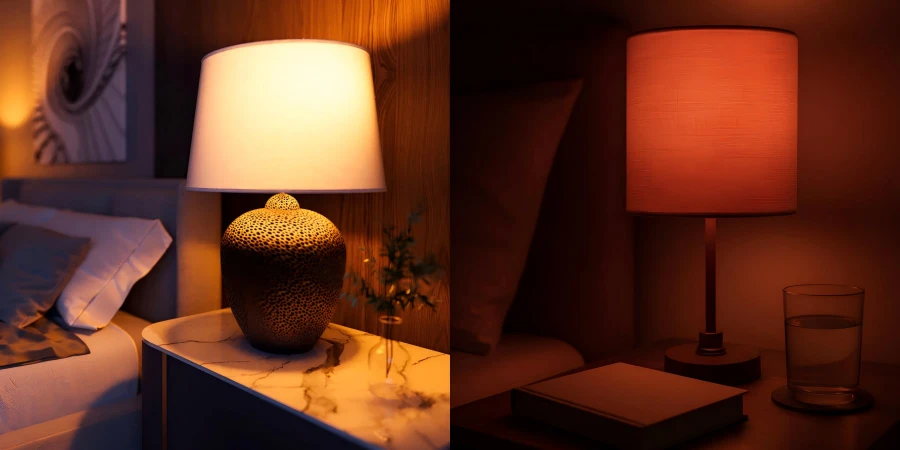
Avoid red as the only reading mode for illustrated books or color-coded notes. Keep white available for those tasks, and judge amber using the actual paper and print size.
What brightness settings should a bedside reading lamp offer?
A bedside reading lamp should provide a clear reading level and a lower setting for brief nighttime use. Brightness should also be adjustable in every color mode offered for reading.
Define a reading level and a lower bedside level
Specify the two uses separately:
- Reading: enough light across both pages to make the intended print clear, with adjustment available above and below that level.
- Brief nighttime use: enough light to find a nearby object, without returning to the full reading setting. This level does not need to reveal fine print.
For a three-step design, start with low for brief bedside use, middle for ordinary reading and high for smaller print or readers who need more light. Confirm the actual outputs on a sample.
Describe the lower setting as a bedside or nighttime option when that is its purpose. Avoid presenting every available brightness level as equally suitable for reading.
Choose fixed steps or stepless dimming
Fixed brightness steps provide repeatable levels with a few button presses. Check the gaps: one step should not leave the page too dim while the next feels uncomfortably bright.
With stepless dimming, users can adjust brightness continuously within the available range. For press-and-hold controls, check the adjustment speed: the user should be able to stop at the intended level without repeatedly overshooting it.
Make color changes and power-on behavior predictable
Keep color selection and brightness adjustment separate where practical. A reader should be able to increase the light on a page without cycling through white, amber and red first.
When the color changes, check the resulting brightness rather than assuming the same button position produces the same output. White, amber and red need their own usable adjustment ranges.
Also decide what happens when the lamp is switched on. It can restore the previous color and brightness or start at an agreed default. Specify which behavior the product needs; a memory function that retains color alone will not reproduce the previous reading setting.
Should you choose a circadian bulb or a clip-on reading light?
Choose a bulb when customers want to keep an existing lamp. Choose a clip-on when they need a directed reading beam and have a suitable mounting edge.
A19 bulbs for an existing bedside lamp
Our amber and red A19 bulbs are rated at 9 W and offer E26 or E27 base options. Watts measure electrical power, so equal wattage does not mean equal light output or reading performance.
Match the base and voltage, then check the bulb with the intended shade. Both models are dimmable; confirm compatibility with the exact dimmer and bulb version.
Our amber bulb provides a single light color; it does not switch to white or red.
A three-mode clip-on for focused reading
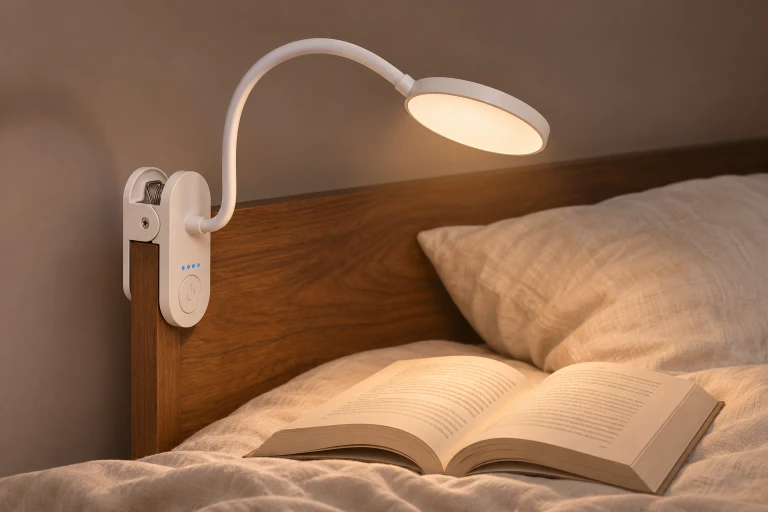
Our rechargeable clip-on reading light combines white, amber and red with separate brightness buttons. Its 38 cm flexible gooseneck lets the user aim the head, and the clamp frees the nightstand surface.
This format suits a reading-light product line when customers need several modes in one lamp. Check the arm’s reach with the reader holding the book: a clamp can fit the furniture while the head still falls short of the page.
What should a brand specify before ordering?
A bulb for a shaded nightstand lamp and a clip-on attached close to a paperback need different coverage, mounting and controls.
Copy these fields into a sample request or inquiry:
Product format: [A19 bulb / clip-on reading light]
Main use: [reading / evening ambient light / brief nighttime use]
Lamp or mounting position: [fixture, headboard or shelf; distance to book if known]
Reading material and modes: [plain text or illustrated pages; white, amber or red]
Target market and quantity: [country; estimated units]
Before approving the product description, confirm these details with the supplier:
- Brightness by mode: request lumen figures and page-lux measurements with the distance, setting and mounting position stated. One white-mode figure does not describe amber or red output.
- Color claims: ask for a model-specific spectral report before making a numerical or absolute “blue-light-free” claim. Kelvin and nominal wavelength labels alone do not establish it.
- Power-on behavior: specify whether the lamp should restore its previous color and brightness or start at a fixed setting. A “memory” feature may retain one setting without retaining both.
For a bulb-based product line, start with amber and add a red option if brief nighttime use is also a priority. For focused reading, the three-mode clip-on already offers white, amber and red in one product.
To discuss a bedside reading-light specification, send the completed fields with any available fixture or mounting photos.