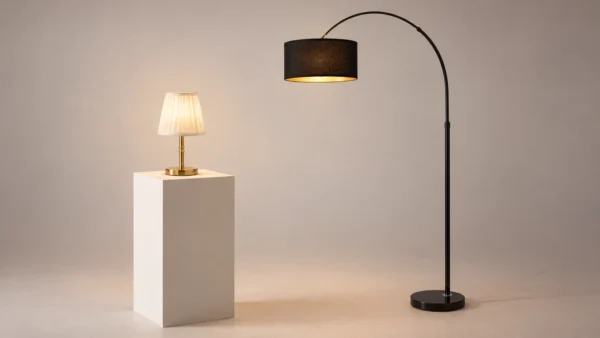
At 9 p.m. you switch your ceiling light to its warmest setting. The room looks softer, but the light still reaches every wall. The warmer color can help before bed. If the room is still bright, dimming the light can help too.
Circadian lighting means planning light exposure around the body’s roughly 24-hour clock. At home, the aim is to get more light at your eyes during the day, less in the hours before bed, and as little as practical while you sleep. You can start by changing the way you use the lights you already have.
How Does Light Set Your Body Clock?
When light enters your eyes, it reaches the retina, the layer at the back of each eye that detects light. Some cells there contain melanopsin, a pigment that responds strongly to blue light. Those cells carry light signals along the optic nerve, the connection between the eye and the brain. Some of those signals reach a small group of brain cells that acts as the body’s central clock.
The clock uses those signals to stay aligned with day and night. More light at your eyes generally produces a stronger signal. The mix of wavelengths in the light also plays a role. Wavelength is the distance between peaks in a light wave. Blue light has shorter wavelengths than red light. The full mix is called the light’s spectrum.
Why Timing Matters
Melatonin is a hormone that signals nighttime to the body. Its level usually starts rising before you go to sleep. Evening light can blunt that rise while you’re exposed to it. In one experiment, people’s melatonin began rising later under ordinary room light than under dim light. Check the room lights as well as your phone screen.
Light can also shift the timing of the clock itself. Bright light early in your body’s usual nighttime period can move the clock later. Bright light toward the end of that period can move it earlier. Researchers can check for a shift by measuring when melatonin rises again under dim light.
Duration matters too. Even at the same brightness, a quick trip down the hall is a much shorter exposure than an hour under a reading lamp.
How Much Light Reaches Your Eyes?
One home study used wearable sensors to measure light in the three hours before bedtime. The researchers accounted for how strongly different parts of the light stimulate melanopsin. The average readings varied about twentyfold across homes. That gives you a reason to look at the room you actually spend your evening in, from the seat you normally use.

Is Warm Light Enough Before Bed?
A warmer setting can reduce the blue light a fixture gives off. If the ceiling light is still on full power, it can send plenty of light toward your eyes. Check how bright the room is from where you sit, even after you’ve changed the color.
What the Bulb Label Tells You
Color temperature describes how warm or cool a light looks. It’s measured in kelvin, written as K. An 1800 K amber A19 bulb gives a compatible bedside lamp a warm glow. A19 describes the bulb’s familiar pear shape and size. In one lab experiment, researchers used two white lights with the same color temperature and the same ordinary light meter reading. The lights contained different mixes of wavelengths and had different effects on melatonin.
Lumens measure the total visible light a bulb puts out. Illuminance describes how much light lands on a surface. Lux is its unit.
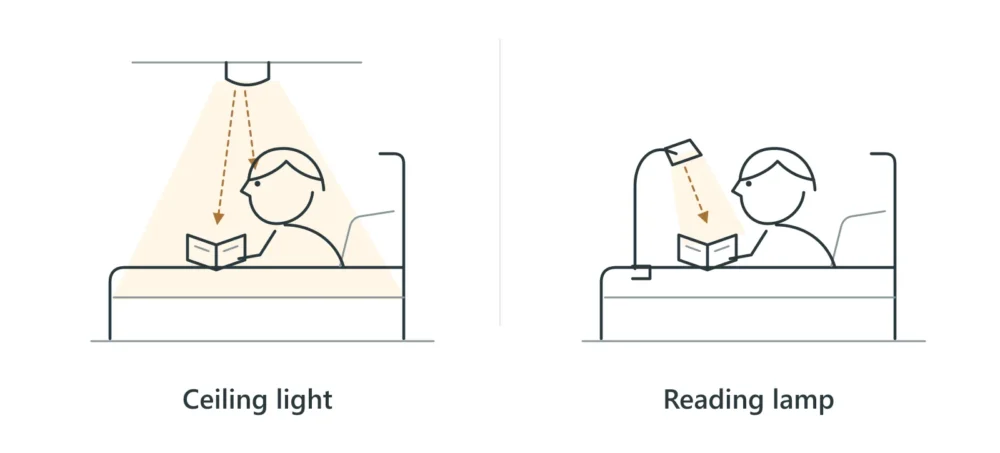
Use the bulb label to choose the color and total output. To judge the effect on your body clock, you also need the spectrum and the amount of light that reaches your eyes. A shade or a narrow beam can keep the page well lit while reducing the light at your face.
What to Change First
If the room still looks bright after you change the color, lower the brightness. For reading, a clip-on reading light lets you keep the light close to the book while the rest of the room stays dim.
What Does a Day-to-Night Lighting Schedule Look Like?
Work backward from your usual bedtime. If you usually go to bed at 11 p.m., 8 p.m. is a reasonable time to start reducing unnecessary room light. If you go to bed at midnight, that same three-hour window starts at 9 p.m. During the day, give yourself access to brighter light. If your desk gets little daylight, a break outdoors changes your exposure in a way that moving a desk lamp closer to your paperwork may not.
A regular light meter reports lux based on how bright the light looks to human vision. The targets below use a different measure called melanopic EDI, short for melanopic equivalent daylight illuminance. It tells you how much standard daylight would stimulate melanopsin as strongly as the light being measured. Both measures use lux, so look for the words melanopic EDI when comparing a reading with the table.
| When | Expert target at the eye | What that looks like at home |
|---|---|---|
| During the day | At least 250 lux melanopic EDI | Use daylight when available. Add room lighting if your usual daytime spot is dim. |
| Starting at least three hours before bed | At most 10 lux melanopic EDI | Reduce the light that fills the room. Keep enough light for the activity you’re doing. |
| During sleep | At most 1 lux melanopic EDI | Keep the room as dark as practical. If you get up, use enough light to see where you’re going. |
How Can You Check Your Bedtime Lighting at Home?
Compare Two Setups Without a Meter
Try this from the spot where you usually read. Keep the book and your seat the same.
- Read a few lines with your usual lights on. Look up and notice any bare bulb or brightly lit wall in front of you.
- Dim the room light or switch to your reading lamp. Check the page and look up again.
- Keep the setting if the page is still easy to read and less light fills your view. Move the reading lamp to one side if your hand casts a shadow on the text.
If you want the room light to dim at the same time each evening, a smart bulb with a timer can do it automatically.
Compare Dimming Levels With a Lux Meter
Take a reading at eye height, with the meter’s sensor facing the way you normally look. Then dim the lamp and measure again from the same spot. Use the readings to compare brightness while the lamp’s color stays the same. Laying the meter flat on the book measures light on the page. When you switch colors or bulbs, judging the effect on melanopsin also requires information about the light’s spectrum.
When Should You Use Amber, Red, or White Light at Night?
Pick the color once you know what you need to see. A shaded lamp with an amber bulb suits a bedside area that needs a little general light. If you can still see the bulb directly from your pillow, try changing the shade or moving the lamp before replacing it again.
A deep-red A19 bulb can light a short, familiar route. Its specified wavelength is 670 nanometers (nm), which puts its light in the deep-red part of the visible spectrum. Check that you can see the full route, including any step or obstacle. Deep red can make colors harder to distinguish. For reading a label or finding a specific item, use a light that gives you enough detail to do it safely.
For reading, start with amber if the text is easy to see. Switch to white at a comfortable level if the fine print looks faint or you need to tell colors apart. On our clip-on reading light, separate controls let you adjust the color and brightness one at a time.
Start With the Light You Use Longest
Tonight, start where you spend the most time before bed. If that’s the couch, try turning down the main room light while you watch TV or keep a nearby lamp on for reading. Give it a few minutes. If you can still see comfortably, keep that setting for tomorrow night.