
Picture a restaurant putting new cordless lamps on every table. A few months later, one cuts out when the staff turns it up. Another still looks bright but needs charging halfway through service. If you source cordless LED table lamps for a brand, either problem can lead to a return. The first step is figuring out what went wrong.
Both problems can show up before the LEDs have lost much brightness. Good-quality white LED products can be rated for 30,000 to 50,000 operating hours or more. To see what that figure tells you about the lamp you’re buying, check what the supplier actually rated.
What Does 50,000 Hours Mean for an LED Light?
L70 at 50,000 hours means the light is expected to give 70% of its original output after 50,000 hours under the conditions used for the rating. If it starts at 100 lumens, that means about 70 lumens. L70 is the shorthand for that 70% mark. You’ll see it in both U.S. and European lighting guidance.
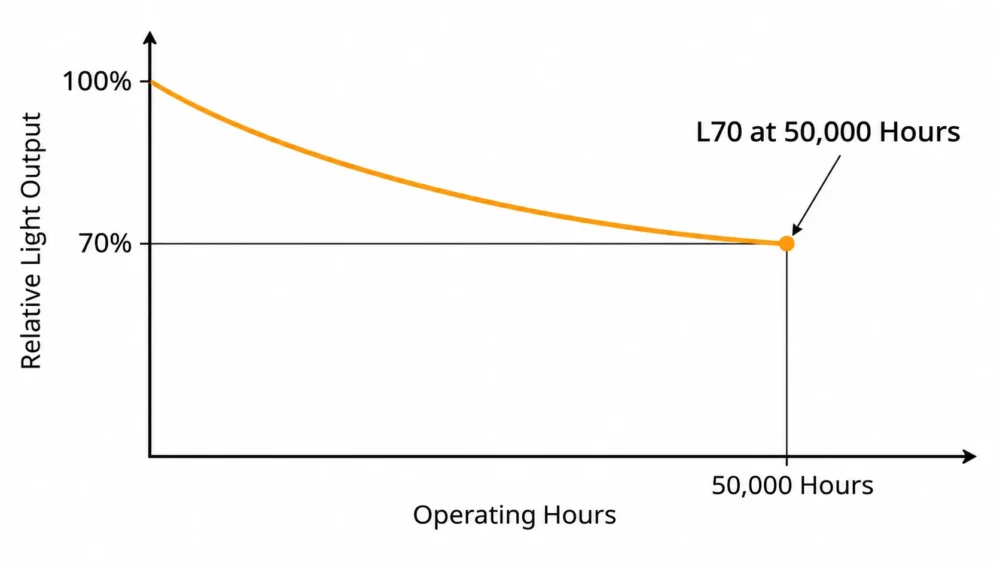
At eight hours a day, it would take about 17 years to reach 50,000 operating hours.
Where Does the 50,000-Hour Number Come From?
A supplier may base that number on LM-80 and TM-21, two methods published by the Illuminating Engineering Society (IES). In an LM-80 test, a lab measures how much light an LED gives over time. TM-21 uses those readings to estimate when its output will reach a level such as L70.
Does That Rating Cover the Whole Lamp?
It depends on what the spec sheet rates. If it names the LED inside the lamp, the number tells you how that LED is expected to fade. When comparing quotes, record the LED rating and the repair or replacement period from the written warranty separately.
Even with a long LED rating, the lamp can go dark if its driver fails.
Why Do Integrated LED Lights Fail Early?
In a cordless lamp, the battery provides the power, the driver controls how much current reaches the LEDs, and the control circuit responds when you turn the light on or dim it. The driver and controls may share a board. What the lamp does when something goes wrong gives you a starting point for checking these parts.
What the Symptoms Can Tell You
- The lamp flickers, takes longer than usual to turn on, or cuts out. An unstable driver or power circuit can interrupt light output while the LED still works. Record when the problem starts and which settings trigger it. Flicker alone cannot tell you which part failed.
- The lamp turns on but ignores taps or skips a setting. Include the touch control and dimming response in the check. A lamp that stays on can still have a control fault.
- The battery runs down sooner or the lamp fails to charge. If a full charge runs out sooner, compare hours per charge at the same brightness. If charging itself cuts in and out, record which charger you used and when the problem happened. That gives the supplier a way to check the charging setup.
How These Parts Fit Into a Table Lamp
On iLEDGlow’s aluminum mushroom cordless table lamp, a 3 W LED module provides the light, a touch control changes the brightness, and a USB-C port charges the battery. These are three things you can check on a sample without opening the lamp.

Does Heat Shorten LED Lifespan?
Yes. Higher operating temperatures can speed up light loss and put more stress on the driver electronics. Heat has to move away from the LED. One common route is through the circuit board and lamp body into the surrounding air. You can’t tell how well a lamp sheds heat by looking at its finish.
What Changes When a Lamp Runs Brighter?
Two lamp heads can look the same while running the LEDs at different currents. If the brighter lamp draws more current through the LEDs with the same cooling and driver capacity, the components can run closer to their limits. More efficient LEDs or a design that sheds heat better can change that trade-off.
Compare samples at the brightness you intend to sell or specify. If a quote promises higher output from the same lamp head, get the operating conditions and any temperature measurements for that configuration. A quick touch of the housing cannot tell you the temperature of the LED or the driver inside.
Why Do Some LED Lamps Cost Less?
A lower price can come from a simpler finish, cheaper packaging, or a larger order. Start by comparing quotes for the same configuration and quantity. If one is still cheaper, look at what each supplier includes.
How to Compare Two Lamp Quotes
- Compare the parts inside the lamp. Look at the driver and its protection circuits, the parts that carry heat out of the lamp head, and the wiring and insulation materials.
- Check what the factory tests. Find out which incoming parts are inspected, what gets checked on the finished lamps, and how long the lamps run during any aging check. Short checks can catch some early problems. A lifetime claim needs its own evidence.
- Check what happens after delivery. Find out how the supplier handles repairs or exchanges and whether spare parts cost extra. Those details affect what you spend supporting the lamps.
Check for Changes Between the Sample and Production
Once you approve a sample, use that version as the reference for production. If the factory changes the driver, wiring, or an insulating part, record the change and check which test results still apply.
For example, two drivers can have the same wattage but differ in output current or dimming behavior. A written change notice should identify the old and new parts and the first production lot affected. Check the proposed substitution against the approved sample and agree on what to retest before the revised batch ships.
Can Integrated LED Lights Be Replaced?
Some integrated lamps let a technician replace the LED module, driver, or another part. Other models have to go back as a whole lamp for repair or replacement. For any spare you plan to rely on, get the part number, price, and typical delivery time. Confirm who can fit it and who pays for shipping if the lamp has to go back.
For a cordless lamp, check how the warranty treats a battery that still charges but no longer lasts long enough for the intended use. If there is a coverage threshold, record how runtime will be checked and at which brightness.
If you’re deciding how many spares to keep, a return rate for the same model can help. Check how many units it covers, how long they were tracked, and which problems counted as returns.
What Should You Check Before Buying an Integrated LED Light?
Before ordering, put the sample through the same routine your customers will use. Check that it charges with the specified equipment. Note the battery level, then run the lamp at the highest brightness your customers will normally use. Try the controls again once the lamp is warm. If it cuts out, record the sample version, brightness setting, and when it happened so the supplier can repeat the check.
Five Items for Your Sample Approval Sheet
| What to confirm | What to record before placing the order |
|---|---|
| 1. What does the lifetime rating cover? | The rated part, output threshold, operating conditions, and supporting report or projection. |
| 2. Does the sample meet the agreed checks? | The sample model and version, the test conditions, and the pass criteria for each check. |
| 3. What happens if a key component changes? | Which changes require written notice before production, who approves them, and what gets checked again. |
| 4. What does the warranty cover? | Coverage period, covered parts, and which party handles repair, exchange, and freight. |
| 5. Which spare parts can you actually get? | Part numbers, prices, expected lead times, and who can fit them. |
Keep the completed sheet with the approved sample. If a lamp goes dark during service, the customer wants a working lamp back. Agree on who will fix or replace it while you can still change the design or the order terms.
If you are comparing a model or developing one for your brand, discuss a table lamp sample with iLEDGlow. Tell us where the lamp will be used and what you want the sample to do.