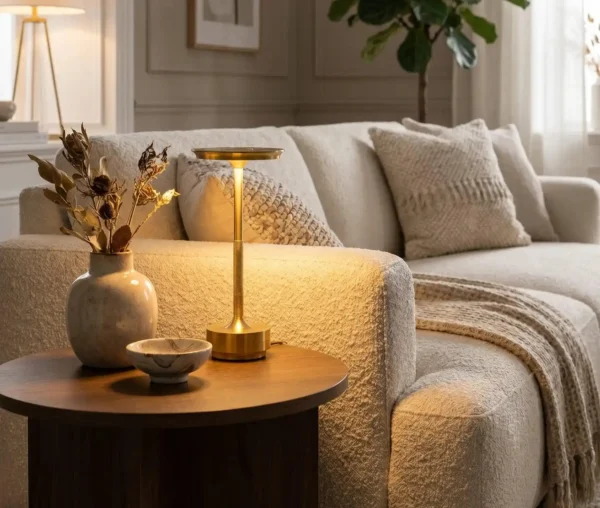
An arc floor lamp brings the shade over your sofa or reading chair while its base stays beside the furniture. A tripod keeps the shade above its legs, making it a natural option alongside a seat.
When choosing floor lamp styles, we recommend starting with your usual seat. Where would you like the light to fall? Is there room for the lamp beside you, or does it need to reach over the sofa? That’s the practical starting point for an arc vs. tripod floor lamp comparison.
Where do arc and tripod floor lamps put the light?
An arc brings the light forward from its base, while a tripod lights the area around where it stands. Once the shade is in the right place, its material and the bulb determine how that light spreads.
A downward-facing opaque shade sends light through its opening. With a translucent fabric shade, some light also passes through the sides for a softer glow. Both arc and tripod designs can use fabric shades, so an arc can light your seat from above while adding ambient light around it.
A lamp can brighten the coffee table and still leave your book in shadow. Sit where you normally read, with the book in your lap, and see whether the light reaches the page comfortably. A tripod beside your shoulder can work well here; an arc is useful when the base needs to stand farther away.
For a relaxed evening glow, the shade’s transparency matters as much as the shape of the lamp. A darker lining lets less light through the sides. In a larger living room, either design can work alongside other lights, so the seating feels inviting without relying on one lamp to brighten every corner.
The view from your seat matters too. A fabric shade can look softly lit across the room, yet reveal the bulb through its lower opening when you sit close by. A small change in position can make that seat more comfortable.
How much reach does a floor lamp over a couch need?
An arc is useful when you’d like light over a seat but have nowhere to put a lamp base there. Its curved arm brings the shade across the furniture while the base stays beside or behind it.
Start from where the upright would stand and measure across to where you want the shade’s center. Include the gap behind the sofa as well as the distance across its back. This tells you whether the arm can reach your seat, something the lamp’s overall height alone won’t show.
For example, say the upright sits 20 cm behind the sofa back, and you want the shade centered 60 cm forward of it. You’ll need about 80 cm of reach from the upright. That’s the distance to compare with the lamp drawing, using the upright and shade center as your endpoints.
Now picture leaning forward to pick up a drink, then standing up from the sofa. The shade needs to leave room for both movements. Its lower edge matters more here than the highest point of the arch, especially if the lamp will hang close to your shoulder.
With our adjustable arc floor lamp with a fabric shade, you can adjust the height and reach around your seating arrangement. Nearby curtains and shelves still need their space.
Which floor lamp fits a small living room?
When browsing floor lamps for small spaces, it’s easy to focus on the slim frame. The base deserves just as much attention: three slender legs can spread farther across the floor than a compact weighted base.
If you hope to tuck an arc base partly beneath the sofa, compare its thickness with the space under your furniture. The sofa feet can get in the way too. Once the base fits, the upright and shade should have enough room without pressing against the sofa.
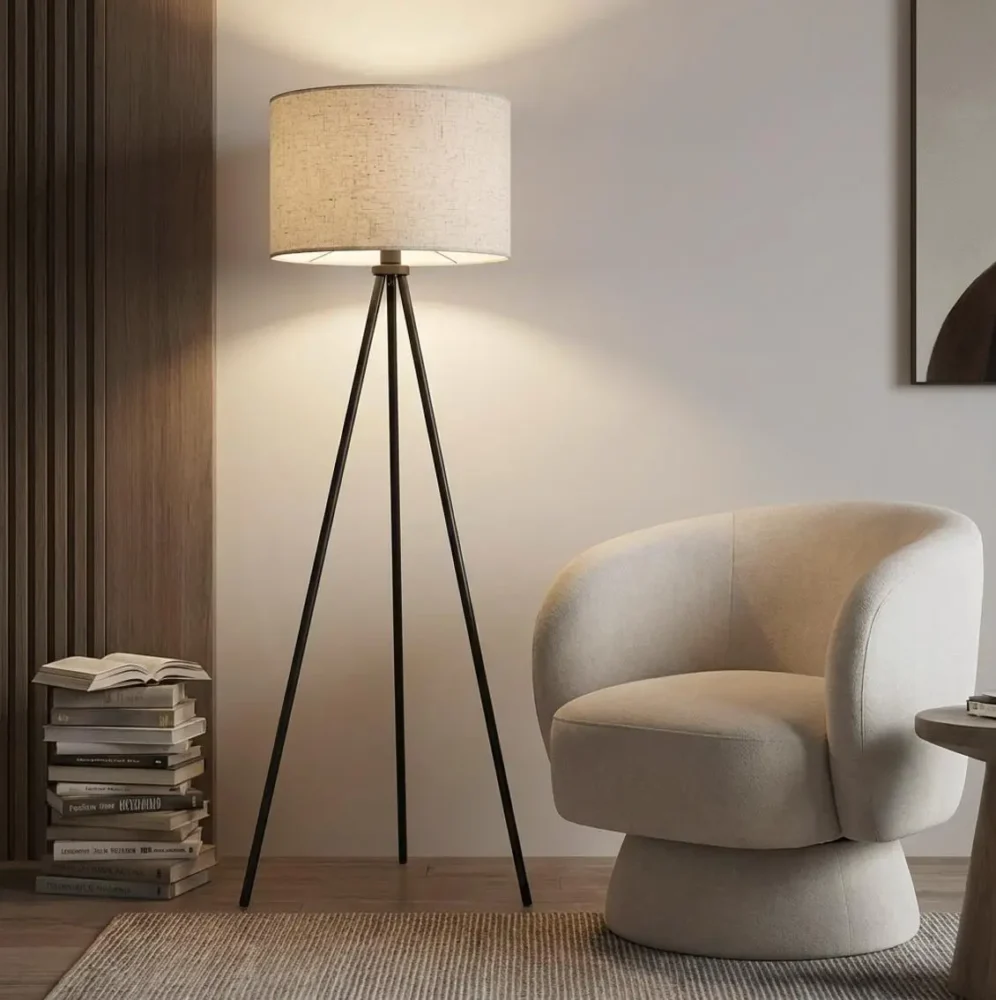
For a tripod, picture the full spread of its feet beside your chair. That open-looking frame still needs a clear patch of floor. Give the side table and any reclining mechanism room to move around it.
Painter’s tape makes this easier to picture. Outline the base or leg spread on the floor, then try your usual route past the sofa and open any nearby doors. You’ll soon see whether the spot works. Remember to leave room above for the shade as well.
Where should a floor lamp go in a living room?
We’d choose the position around the seat you use most, then work back to where the base can comfortably stand. A floor lamp behind a couch brings different possibilities from one beside the arm.
| Placement | Arc floor lamp | Tripod floor lamp |
|---|---|---|
| Behind a sofa | Useful when the base fits and the arm reaches the chosen seat | Works if the legs fit and the shade remains clear of the sofa back |
| Beside a chair | Brings the shade over the lap without putting the base there | Provides nearby shaded light when the feet clear the chair and side table |
| Open-plan living room | Reaches into a seating group from its edge | Adds ambient light beside the group with space for the leg spread |
| Narrow corner | Check both base fit and overhead projection | Check the full spread; three slender legs do not guarantee a narrow footprint |
Placing a floor lamp behind a sofa
If your sofa stands away from the wall, an arc is a good place to start. Its base can sit behind the seating while the arm reaches forward. With a wall-backed sofa, we’d look at the open end first, where the lamp has more room beside the arm.
Choosing a floor lamp for a reading chair
For a reading chair, start with how you like to sit. An upright chair and a recliner put your head and book in different places. A fabric-shade tripod can make a pleasant reading corner beside the chair; an arc helps when the lamp needs to stand farther away. For detailed work, a dedicated task lamp may suit you better.
Placing a floor lamp next to a sofa or in an open room
In an open-plan room, an arc can bring light into the seating group while its base stays at the edge. A tripod also works well beside the group, with its feet away from the walkway. For a tighter corner, let the available space guide the choice rather than the size of the room as a whole.
How do our arc and tripod floor lamps compare in size?
Our adjustable arc floor lamp stands 180 cm tall, while our metal tripod floor lamp with a fabric shade stands 150 cm tall.
| Feature | Our adjustable arc floor lamp | Our metal tripod floor lamp |
|---|---|---|
| Overall height | 180 cm | 150 cm |
| Supporting structure | Metal arm with marble base | Three metal legs |
| Lampshade | Fabric drum shade | Fabric drum shade |
| Adjustment | Telescopic frame; lampshade angle adjusts | Lampshade position adjusts slightly |
| Power cable | 1.8 m | 1.8 m |
The 30 cm height difference gives you a sense of their scale beside your furniture. Their shapes explain how you’d use them: the arc brings its shade over the seating, while the tripod stands alongside it. Both have fabric shades, so you can choose overhead reach and still enjoy light through the sides.
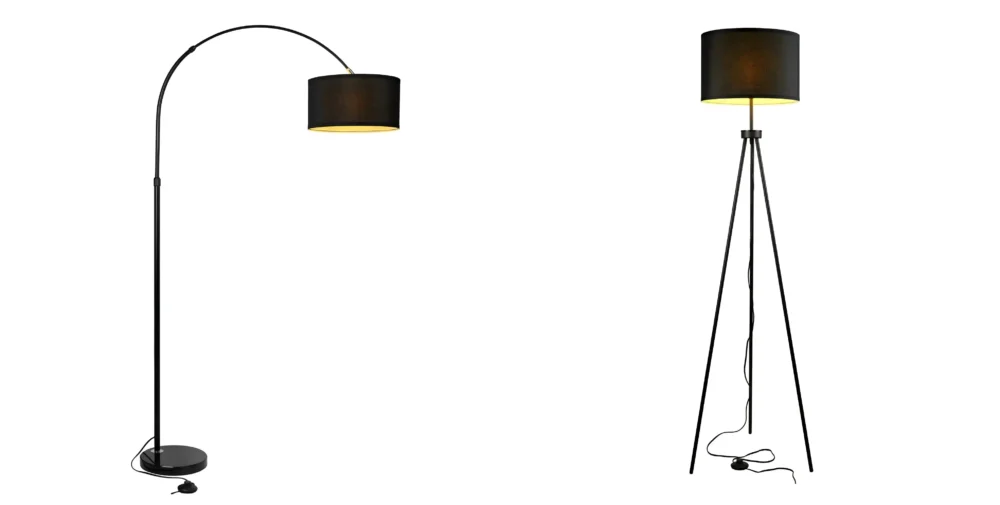
For a sofa with clear floor beside or behind it, we’d look at the arc first. For an armchair with an open corner alongside, the tripod is a good starting point. In either case, leave enough room for a side table and for getting in and out of the seat.
In a tighter layout, we’d keep the base position and shade position together when comparing the two. A lamp that fits neatly on the floor still needs to feel comfortable beside you when you sit down, reach for the side table or get up.
How do arc and tripod floor lamps stay stable?
An arc balances its extended arm with a weighted base, while a tripod gets support from its three spread-out feet. Both need a firm, level place to stand. The important choice at home is a position where the lamp can sit securely without being in everyone’s way.
During setup, give the base connection and adjustable joints a careful look, following the assembly instructions. All three tripod feet should sit firmly on the same surface. A rug edge running under only some of them can make an otherwise suitable spot awkward.
In a busy seating area, we recommend leaving the walking route clear of feet, bases and cables. Try the arrangement with nearby chairs pulled out too, since that’s when an apparently roomy corner can become crowded.
Which is easier to assemble, move and clean?
If you like to rearrange the room, think about how you’ll handle the lamp as well as where it will stand. An arc has a weighted base and a projecting arm to manage; a tripod needs room for its spread-out legs as you move it.
The assembly instructions will show which parts connect separately. Give yourself room to put them together before moving the finished lamp into its corner. When rearranging, unplug it first and support the structure instead of lifting by the shade or curved arm.
For everyday care, a soft cloth handles dust on the base and legs; follow the care instructions for the shade. Tripod feet take a little maneuvering around when cleaning the floor, while an arc’s base can limit access underneath. Leave the switch within easy reach when everything goes back into place.
Check the intended layout before ordering
Once you’ve found a promising spot, take a photo from your usual seat. Include the furniture around it and the nearest socket. It’s a useful reference when comparing lamps, especially when product photos show a much larger room than yours.
Choosing lamps for a retail collection or hospitality project? The same attention to everyday use helps define what you need. Share the intended setting, furniture dimensions, preferred finish, quantity and destination market. You can discuss floor lamp specifications and customization with our team, using that layout as a starting point for model selection and sampling.