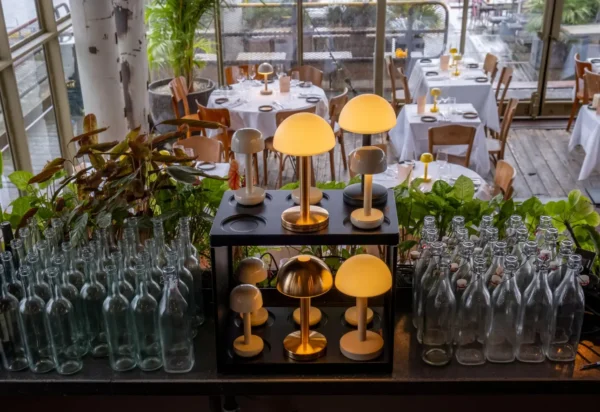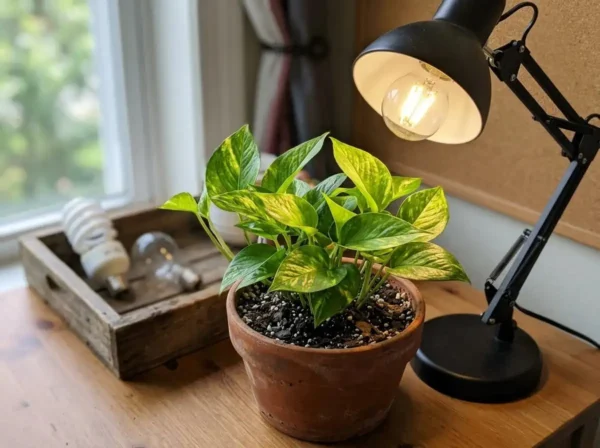

For a traditional table lamp, a useful starting point is a shade whose bottom width is close to the height of the bare lamp body, with a shade height around two-thirds of that measurement. If your existing shade already looks balanced, copying its dimensions is usually easier. Either way, check the attachment before buying: the right proportions do not guarantee the right fit.
For a floor lamp, start with the original shade or the manufacturer’s recommendation. The height of a tall pole alone tells you little about the shade it needs.
How to measure a lampshade
Record the top opening, bottom opening and height separately. A label such as “12-inch shade” may describe only the bottom diameter, leaving the other dimensions and attachment unspecified.
Turn the lamp off, disconnect its power supply and let the bulb cool before removing the shade. Record the units beside every measurement.
Measure the top and bottom openings
Measure straight across the centre of each opening, from edge to edge. Do not measure around the rim.
For an oval or rectangular shade, record both width and depth. A shade that looks narrow from the side can still be wide across the front, which is useful on a shallow console or bedside table.
Check vertical height and slant height
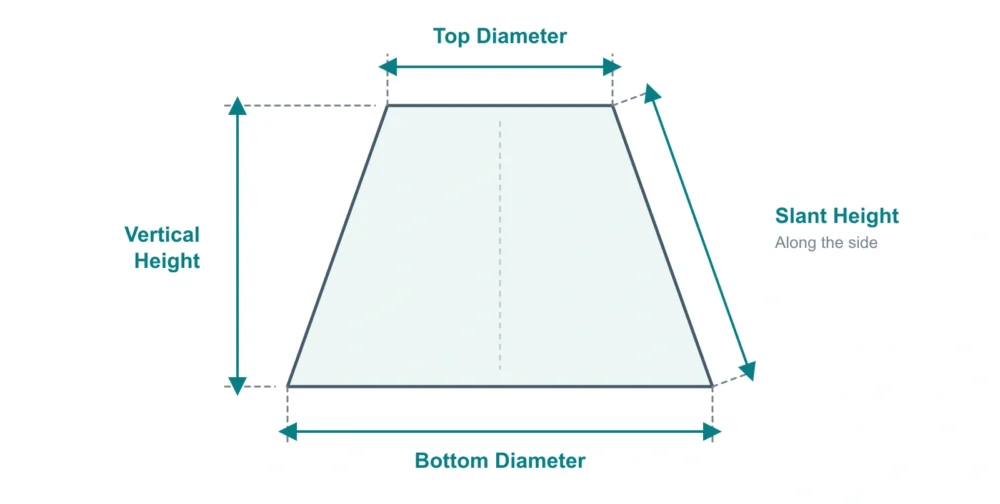
Vertical height runs straight from the level of the top rim to the bottom rim. Slant height follows the angled side. They match on a straight drum but differ on a tapered shade.
A listing written as top × bottom × height is incomplete unless it defines that last measurement. Check the diagram before ordering. Record the fitter position too: otherwise identical shades can sit at different heights on the same lamp.
What lamp base measurements do you need?
Measure the bare lamp body from the bottom of its base to the point just below the bulb holder. Keep the bulb, harp and finial out of this measurement. Then measure the widest part of the body, rather than assuming the foot is its widest point.
Keep the bare-body measurement separate from the assembled lamp’s total height.
| Measurement | What to record |
|---|---|
| Shade openings | Top and bottom diameters; width and depth for non-round shades |
| Shade height | Vertical height, plus slant height if the listing uses it |
| Lamp body | Height to just below the holder; widest body width |
| Attachment | Fitter type, opening size, threads if present, and mounting position |
| Available space | Table width, wall clearance and space around the actual bulb |
Photograph the uncovered mounting hardware alongside these measurements. That photo is often more useful to a shade supplier than a picture of the assembled lamp.
What lampshade size works for a table lamp?
Use proportion rules to shortlist sizes, then judge the assembled silhouette. For many traditional bases, a bottom diameter near the bare-body height and a shade height around two-thirds of that height provide a reasonable first trial.
Another common width guide is roughly twice the widest part of the base. These methods can give different answers on a tall, slender lamp. Choose the shape that balances the actual body and furniture, rather than trying to satisfy both formulas exactly. When comparing complete lamps in our cordless table lamp collection, judge the shade and base together, alongside the table footprint.
A table lamp shade size chart for a first trial
Use this chart as a starting point for traditional table lamps only. These are calculated examples using the height-based guideline, not tested product pairings or guaranteed fits. They assume a body narrower than the proposed shade.
| Bare-body height | Trial bottom diameter | Trial shade height |
|---|---|---|
| 9 in / 22.9 cm | 9 in / 22.9 cm | 6 in / 15.2 cm |
| 12 in / 30.5 cm | 12 in / 30.5 cm | 8 in / 20.3 cm |
| 15 in / 38.1 cm | 15 in / 38.1 cm | 10 in / 25.4 cm |
Adjust for the lamp’s shape and its table
A broad ceramic body often needs a wider shade than a thin candlestick body of the same height. A drum carries its width through the whole shade; a tapered shade has less width at the top, so the silhouettes differ even with matching bottom diameters.
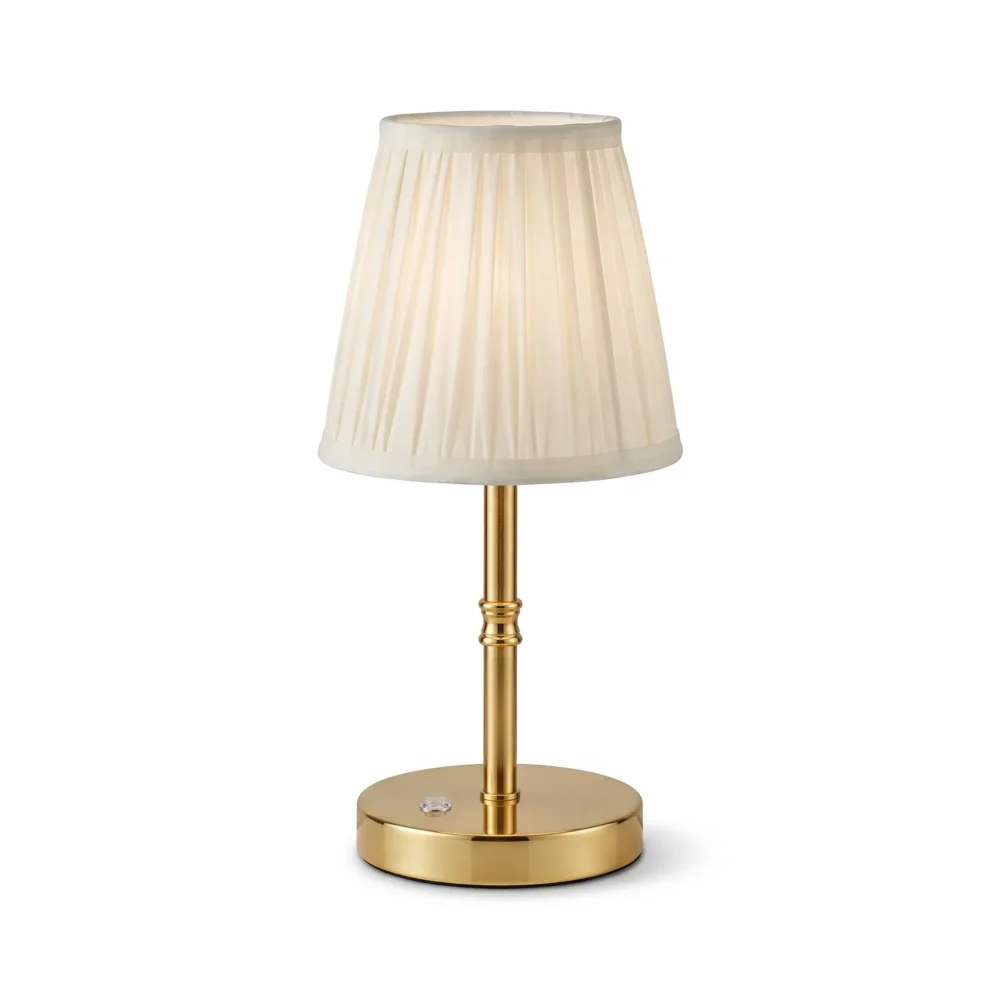
Pictured below is iLEDGlow’s cordless gold table lamp with a pleated fabric shade. Its compact tapered shade sits above a slender stem, leaving much of the lamp body visible.
Check the table footprint as well. Leave room for the objects you use there, and keep the shade clear of the wall. To preview a different width, hold a paper outline beside the switched-off lamp before shopping.
What size lampshade do you need for a floor lamp?
Choose by the floor lamp’s structure, original shade and viewing position. Avoid applying the table-lamp height formula to the full height of a floor lamp: a long pole is not equivalent to a table lamp’s body. Our floor lamp collection includes upright, tripod and arc designs, which position the shade differently around the furniture.
Upright and tripod floor lamps
Look at the shade together with the stand. A wide drum gives the upper part of a slim stand more visual presence; a narrower shade produces a lighter silhouette. Measure nearby furniture and walking space before increasing the diameter.
Arc floor lamps
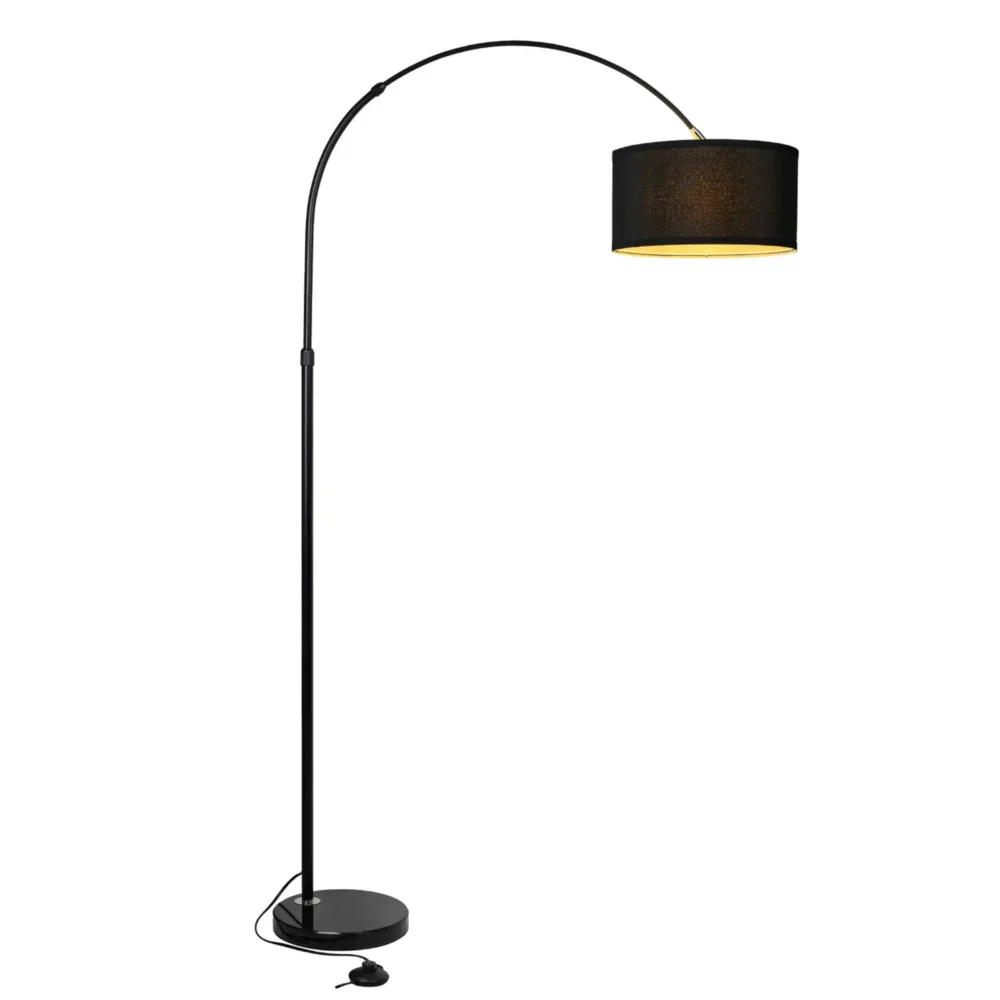
Check where the shade hangs above the chair or sofa. Its diameter affects the space it occupies, while its depth and installed position affect whether you see the bulb from below.
Pictured below is iLEDGlow’s YG033 telescopic arc floor lamp with a marble base. Its broad fabric drum shade hangs away from the base, making the shade’s size and position part of the seating layout.
Sit in the intended seat and check headroom, access and the view of the light source before approving a replacement.
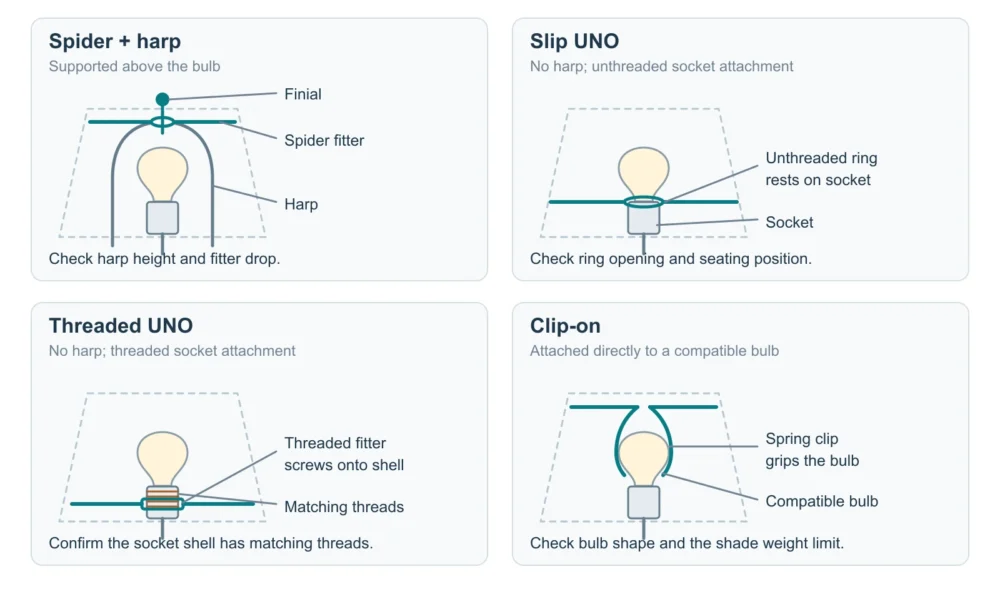
Will a spider, harp or uno fitter fit your lamp?
Match the attachment as carefully as the outer dimensions. The fitter is the part built into the shade that connects it to the lamp; the harp is separate support hardware.
Spider fitter and harp
A spider fitter rests on top of a harp, the metal support that arches around the bulb. A finial secures it. Check the fitter opening, harp attachment and fitter drop, meaning how far the mounting point sits below the shade’s top rim.
Harp height and fitter drop together determine where the bottom rim lands. A taller harp can raise the same shade and expose the socket, even when the shade itself is the right height.
Uno and socket-mounted shades
UNO listings include slip-on and threaded versions. Confirm which you have, the opening size and whether matching threads are required. Other socket-mounted shades use retaining rings; similar-looking rings do not always use the same thread.
An E26 or E27 bulb label identifies the bulb connection, not the shade fitter. Ask for the mounting drawing when a product page gives only the bulb type.
Clip-on and other fittings
Clip-on shades attach to a compatible bulb shape. Check the specified bulb and weight limits. Duplex shades, reflector-bowl fittings and proprietary mounts need their corresponding supports. Identify the existing system before selecting an adapter.
How do lampshade shape and fabric affect light and glare?
Fabric and lining control how much light passes through the sides; the openings and bulb position control where the remaining light goes. A wider shade does not automatically make a lamp brighter or eliminate glare.
Light, translucent fabric can spread light into the room. Opaque fabric or lining directs more output through the openings. Check the complete shade construction: the visible fabric colour alone does not tell you how translucent it will be.
A drum and a tapered shade have different opening sizes and profiles, which changes where the shade intercepts light. For reading, look at the page as well as the lamp. From your normal seated position, the shade should screen the bright bulb while allowing useful light onto the task. Repeat that check if you change the harp, bulb or shade height.
How much space should you leave around the bulb?
Use the lamp, bulb and shade manufacturer’s instructions for clearance. The required space depends on the actual bulb, its wattage, the shade material and the openings. A single gap cannot cover every combination.
Check the narrowest part of a tapered shade, the mounting hardware and any top diffuser. Nothing should press against the bulb. Keep within the lamp’s rated wattage and check any additional limit specified for the shade.
For an LED bulb, use actual power consumption when checking a wattage limit, rather than its incandescent-equivalent brightness label. Also check whether the bulb permits the intended enclosure. A lamp with a fixed LED light source may use a dedicated shade assembly; follow its replacement instructions before adding a different cover.
What should you check before ordering a replacement shade?
Before ordering, confirm the top and bottom dimensions, height definition, fitter opening and mounting position. A lampshade size calculator can suggest proportions, but it cannot confirm physical compatibility. Keep the original shade until you have checked the replacement’s position, switch access and light from your usual seat.
At iLEDGlow, we manufacture table and floor lamps with fabric shades. If you are sourcing a complete lamp for your brand or project, send us your lamp requirements, including reference photos, preferred shade shape, target dimensions and order quantity. We can discuss suitable models and customization options with you.