For frequent use, a rechargeable table lamp is often convenient when charging fits the user’s routine. Replaceable batteries make sense when keeping spare cells on hand is more practical than waiting for a charge. Some lamps combine recharging with battery replacement, so check both how power is restored and how the battery can be replaced.
For DTC brands developing a table lamp, these choices also shape the customer experience, base design, and after-sales support. Start with how your customers will use the lamp, then compare the charging and replacement options before choosing a product platform.
Are Rechargeable and Battery-Powered Table Lamps the Same?
Yes. A rechargeable table lamp is battery-powered whenever it operates without a cable. In retail language, however, “battery-powered” or “battery-operated” often means a lamp that takes replaceable AA or AAA cells, while “rechargeable” usually means a lamp with an internal battery and a charging port or dock.
However, this retail shorthand overlooks hybrid systems—such as lamps that use removable rechargeable battery packs or standard-format rechargeable cells.
The Three Power Systems
The practical categories are therefore:
- Built-in rechargeable battery: The user charges the lamp rather than opening a battery compartment.
- Replaceable standard cells: The user inserts new AA, AAA, or another specified cell type when the installed set is depleted.
- Removable rechargeable battery or pack: The battery can be recharged and later swapped or replaced.
Check the battery instructions rather than relying on the product name. A “battery-operated” lamp may still contain a built-in rechargeable battery, while a “rechargeable” lamp may use removable cells.
Built-In vs. Replaceable Batteries for Table Lamps: What Actually Changes?
The main difference is not whether the lamp is cordless. All three systems can remove the cable during use. What changes is how the user restores power and what happens when the battery no longer provides acceptable runtime.
| Power system | How power is restored | Main advantage | Main trade-off |
|---|---|---|---|
| Built-in rechargeable battery | Connect a cable or place the lamp on a dock | Clean exterior and a simple daily charging routine | The whole lamp may be unavailable while charging, and battery service depends on the design |
| Replaceable AA/AAA cells | Insert another compatible set | Immediate swapping with widely available cells | Spare cells must be stored and replaced; the battery door takes space |
| Removable rechargeable pack | Recharge the pack or exchange it for a charged spare | Combines recharging with possible fast swapping and later battery replacement | Requires compatible packs, accessible contacts, and a spare-parts plan |
Built-in designs suit a clean base and regular charging. Standard compartments suit occasional use with common cells. Removable packs suit applications where downtime or serviceability justifies extra parts.
These are architecture choices, not quality grades. Compare current cordless table lamp platforms by their battery access and charging method, not by the word “cordless” alone.
Which Battery System Is Better for a Table Lamp Used Every Day?
A rechargeable system usually fits daily use better because charging can become part of the routine. This fails if the lamp lacks a convenient charging place.
For one home lamp, that may mean connecting a USB-C cable overnight. For dozens of restaurant or hotel lamps, the decision includes charging space, dock quantity, staff time, and spare units.
Replaceable cells shift the work rather than removing it. Users need charged or new cells on hand and must open each lamp. This works better for occasional use or locations without regular charging access.
Do not compare operating cost with a generic claim that one system is always cheaper. For replaceable cells, estimate:
Number of lamps × cells per lamp × expected changes per year
For rechargeable lamps, account for charging equipment, spares, staff handling, and eventual battery service. Choose the maintenance routine that still makes sense at the intended quantity.
How Does Battery Type Affect Table Lamp Brightness and Runtime?
Battery type alone does not determine brightness or runtime. Performance comes from available energy, LED load, driver design, brightness setting, diffuser, and the light directed onto the intended surface.
A lamp can claim a long runtime at a low setting. That is irrelevant if the user needs maximum output to see a menu or read. Compare runtime at the brightness you will use, not only the longest published figure.
Power regulation controls how the lamp feels near the end of a charge. One model may maintain similar output; another may become visibly dimmer. Check the product rather than assuming a battery label predicts this behavior.
Capacity, brightness, and session length work together. For this comparison, the important point is simpler: choose the required light first, then evaluate which battery system can provide it for the required time.
Is a Rechargeable Table Lamp With a Replaceable Battery the Best of Both Systems?
It can be when the lamp must return to service quickly or remain useful after the original battery loses capacity. But “rechargeable and replaceable” describes several different systems.
A lamp using rechargeable AA or AAA cells can accept a fresh compatible set without a proprietary pack. The manual must still specify the correct chemistry and voltage; a familiar size does not make every battery suitable.
A removable pack can make swapping faster and keep the exterior cleaner than a battery door. The trade-off is dependency on its connector, charger, and future availability. Some lamps instead use a complete removable lighting module.
What “Replaceable” Should Mean
Before treating replaceability as a benefit, ask four questions:
- Can the intended user replace the battery, or is replacement a service procedure?
- Does removal require tools?
- Can a compatible replacement be ordered separately?
- Will opening the compartment affect the lamp’s protection against moisture or dust?
Replaceability is valuable only when the replacement process and the replacement part are both realistic.
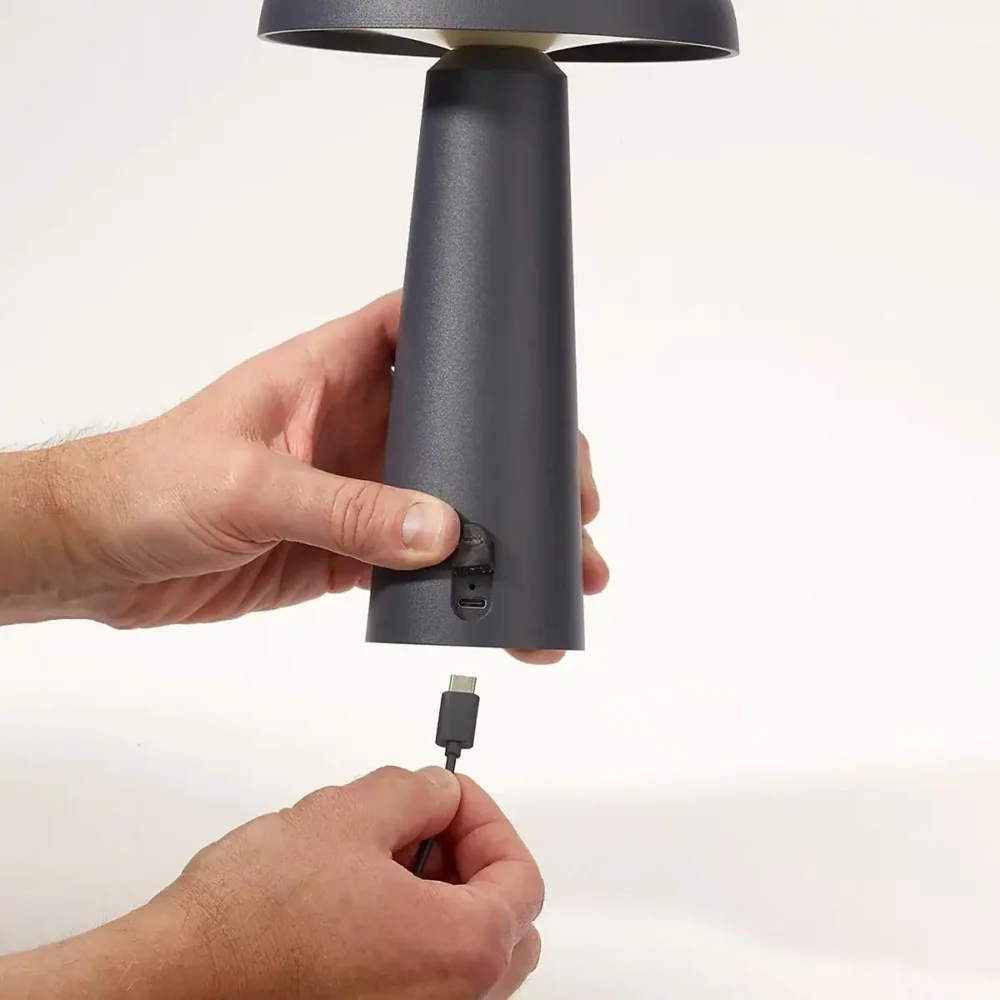
How Do USB-C Charging, Battery Compartments, and Charging Docks Affect Lamp Design?
These everyday charging and replacement needs also shape the physical design of the lamp, from the base and battery access to the charging connection.
USB-C Ports
USB-C can keep charging familiar, but the port still needs an accessible location. The specification must state whether the lamp can operate while connected; the connector shape does not answer that question.
Battery Compartments and Charging Docks
An AA or AAA compartment needs room for cells, contacts, polarity markings, and a cover. Screws slow routine changes; a tool-free latch is quicker but adds a visible seam and wear point.
Contact docks remove the need to insert a cable into each lamp. They help a fleet only if each lamp seats reliably and the charging area holds enough units. Removable packs instead allow separate charging and swapping.
What a Built-In Battery Means in a Current Product
To see how these specifications translate to a real-world commercial application, consider the iLEDGlow fabric-shade cordless table lamp. It utilizes a built-in 2600 mAh rechargeable battery, USB-C charging, and lists 6–8 hours of runtime.
The whole lamp is therefore the unit that gets charged. There is no quick way to restore power by inserting a fresh pack. A venue should compare the published runtime with its required brightness and event duration, then decide whether it needs a charging window or spare lamps.
What Should Brands Specify for a Cordless Table Lamp?
For a DTC brand, the next step is to turn these use requirements into a product brief. Define the customer’s charging routine, required runtime, and battery replacement needs before choosing a lamp platform or requesting samples.
A Product Brief Checklist
Confirm these points before sampling:
- Use pattern: How often will the lamp run, for how many hours, and at which brightness?
- Downtime tolerance: Can the lamp wait while charging, or must the user swap in a charged battery or module?
- Battery access: Should the battery be sealed inside, service-replaceable, or directly replaceable by the user?
- Charging setup: Will each lamp use USB-C, a contact dock, or a shared multi-unit charging arrangement?
- After-sales plan: Who will supply compatible replacements, who may install them, and how long will parts remain available?
- Physical design: How much base volume is available, and how important are a seamless exterior, low weight, or resistance to moisture?
- Instructions and market: What battery warnings, replacement directions, transport documents, and configuration-specific compliance work are required for the destination market?
Set battery capacity after defining output and runtime. More capacity can increase space, weight, charging time, and cost; it is not a free upgrade.
Add these decisions to a private label rechargeable table lamp brief before requesting samples. If a supplier offers only one architecture, the brief exposes that limitation while the platform or concept can still change.
If the brief points to a built-in rechargeable design, review the available custom LED lamp battery and charging options before sample confirmation.
Built-In Rechargeable or Replaceable Battery: Which Should You Choose?
Choose a built-in rechargeable system when the lamp will be used frequently, a clean exterior matters, and charging can become part of the routine. Choose replaceable standard cells when use is occasional and common spares are easier to manage than a charger.
Consider a removable rechargeable pack when fast swapping or long-term battery replacement justifies the extra parts and support. The most durable choice is not automatically the battery that can be removed. It is the system whose charging method, replacement path, and spare availability have been planned for the expected life of the lamp.