You spec a batch of solar garden lights for a hotel courtyard or a restaurant terrace. They work beautifully through summer — on at dusk, off at dawn, no wiring, no electrician. Then November hits. The lights get dimmer, then some stop turning on entirely. Guests are eating in the dark and the property manager is on the phone.
The lights probably aren’t broken. Solar lighting is a small system of four parts — a solar panel, a rechargeable battery, a controller, and an LED. Understand how those parts work together, and you’ll know exactly which numbers to read on a spec sheet and which questions to ask before you order.
This guide is written for the people who actually live with these lights after they’re installed — hotel and restaurant operators, landscape contractors, and wholesale buyers. They’re part of a wider outdoor lighting range, but this article focuses on the solar side — how the system works, why cheap units fail in winter, how to test a sample before you commit, and what to ask a supplier.
How Do Solar Garden Lights Actually Work?
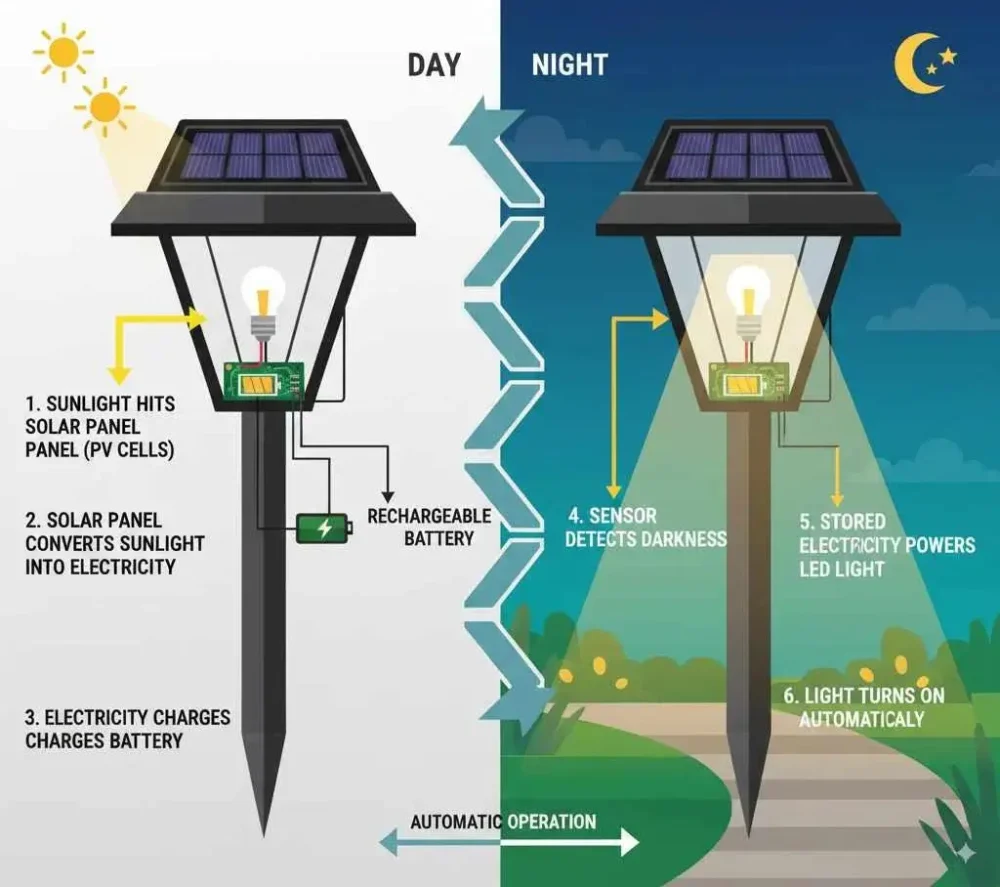
During the day, the solar panel turns sunlight into electricity and stores it in the battery. At night, a light sensor switches the lamp on, and the battery runs the LED until the sun comes back. That’s the whole cycle, every day.
Four parts make it happen. The panel — a small photovoltaic cell, usually silicon — is the generator. The battery, lithium-ion or NiMH, is the storage tank. A controller manages charging and stops the cell from overcharging. The LED is the load — efficient enough to run all night on what a small panel collects in a day.
Think of it as a tiny reservoir. The panel is the catchment, the battery is the tank, the light sensor is the tap. Sunny days fill the tank; the lamp draws it down overnight.
Here’s the part that surprises most buyers: the panel responds to light intensity, not to “is it daytime.” A cloudy day still produces some charge — just far less. That’s why “6–8 hours of direct sun” on a spec sheet isn’t a slogan; it’s the number that decides whether the tank ever fills. And those four parts — panel wattage, battery capacity, charge control, LED efficiency — are exactly the parameters that belong on a supplier’s datasheet. If they’re not there, that’s your first answer.
Why Do Solar Lights Stop Working After a Few Months?
When a solar light “dies” a few months in, it’s almost never a dead LED. It’s a weak battery, an undersized panel, or a bad location — and two of the three are decided at the factory, before you order.
Budget lights use low-grade cells that lose real capacity within a year. The lamp still runs — it just runs shorter every month, until one night it doesn’t. An undersized panel — small enough to keep the price low — never fully charges even a modest battery in real-world sun.
The classic sign is a lamp that comes on fine at dusk and dies two hours in. Most people call it broken. It isn’t. The tank simply never got full. What looks like a hardware failure is a charging-math failure.
The third cause is placement. A light tucked under a tree works in May, when shadows are short, and fails by November, when every shadow runs twice as long. A lamp aimed at a porch or street light can stay off entirely — the sensor never sees darkness. These are installation issues, but they’re your issues unless the supplier documents them in the manual.
Why Do Solar Lights Fail in Winter?
Winter isn’t a product failure. It’s an energy-budget problem: the system’s income drops by half while its expenses stay flat.
Three things happen. Days get shorter and the sun sits lower, so the panel charges for fewer hours at lower intensity — even a clear winter day delivers noticeably less. Cold batteries hold less and discharge faster; a cell that’s fine at 20 °C runs weak at freezing. And snow or ice can sit on the panel for days, cutting off charging completely.
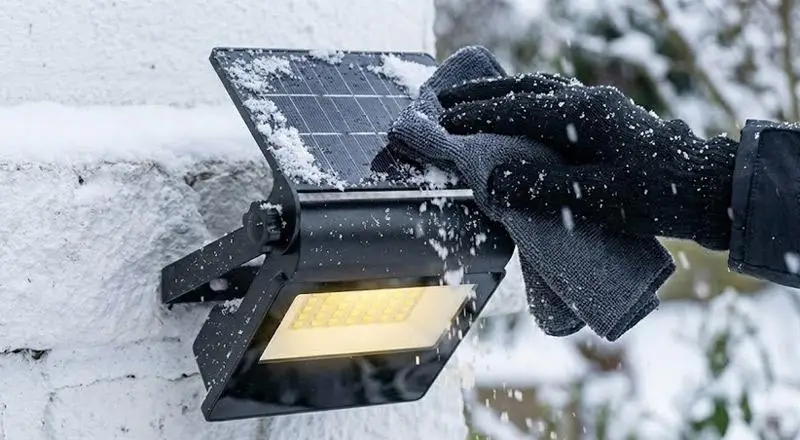
This is where cheap “summer lights” reveal themselves. A unit sized to barely work in July is hopeless in December. The real test of a solar light isn’t a sunny July day — it’s three overcast days in January. Ask the supplier for low-light runtime: how long does it stay lit after a short, overcast charge? A supplier who can’t answer that has never winter-tested the product.
The right panel and battery size depends on your project — your latitude, and how many hours you need lights on each night. A southern restaurant terrace that needs light from 6 pm to midnight has different needs from a northern hotel courtyard that needs dusk-to-dawn coverage.
How to Test a Solar Light Before You Commit
Test a sample before you order in bulk. You can expose most of the problems that surface as “winter failures” in about an afternoon.
Run it through four checks:
- Test the sensor. Cover the panel fully in daylight — the lamp should switch on. If it doesn’t, the sensing logic is faulty.
- Time the real runtime. Charge it fully in direct sun, then run it until it stops and compare that to the spec. A 20% gap is a red flag; a lamp that promises 8 hours and gives 4 is telling you what the battery really is.
- Open the battery compartment. Can the cell be replaced? What type is it? A sealed proprietary battery means the whole unit is disposable when the cell dies.
- Measure the panel. The stated wattage should match the actual cell size. Small panel, big claims — walk away.
A single afternoon of testing tells you more than a month of marketing material. Weak battery, small panel, sealed construction — none of those are visible on a spec sheet. All of them are visible here.
What to Ask a Supplier Before You Order Solar Lights
Before you order, put five questions on your RFQ. The answers separate a light designed for real use from one designed to win a listing.
- Battery. Type, capacity, and can it be replaced on site?
- Panel. Wattage, and how many hours of direct sun does a full charge need?
- Weather rating. IP65 or above — rated for rain, not just splash?
- Low-light runtime. How long does it stay lit after a short, overcast charge?