
Ask ten sources how many hours of light seedlings need and you’ll get answers from 12 to 24 — which tells you most answers are guesses dressed up as precision. The truth is more useful than any single number: what seedlings need is enough total light in a day, and the number of hours that takes depends on how strong your light is. That’s why 14–16 hours is a sensible default rather than a law of nature.
Here’s what that means in practice, why it’s the right default, and the one situation where the number should change.
How many hours of light do seedlings need?
For home growers, several university extension services land on the same range: run the light 14–16 hours a day, then give the plants 8–10 hours of darkness. The University of Maryland Extension, for example, tells growers to keep vegetable transplants under light 14–16 hours a day, placed close enough that the plants stay stocky, and Washington State University Extension recommends roughly 16 hours a day for seed starting.
That range isn’t arbitrary — it’s about giving a small plant a full day’s worth of usable light without wasting electricity. A simple rhythm that fits it is 16 hours on, 8 hours off, timed to run during the day so you can actually see the seedlings.
| Stage | Light per day | Why it matters |
|---|---|---|
| From first sprout | 14–16 hours | Light from day one keeps stems short and sturdy |
| True leaves, growing fast | 14–16 hours | Consistency matters more than exact hours |
| Week before planting out | Keep the same, and start hardening off | Ease them toward outdoor sun, not darkness |
Most vegetable seedlings grow best with a real dark period each night — 8–10 hours is plenty and matches a normal sleep cycle. If you can’t run the full range because of a weak light, lean on the upper end of it (16 hours) rather than cutting down; seedlings under a dim light benefit from more time, up to a point.
Why not just leave the light on 24 hours?
This is the natural follow-up: if light grows plants, wouldn’t more of it grow them faster? The honest answer is that a little more helps up to a point, but running the light around the clock isn’t how seedlings are grown — and there are three practical reasons.
- The standard guidance builds in a dark period. University extension advice and grower guides such as Burpee’s seed-starting guide recommend a nightly dark period and specifically tell you not to leave lights on 24 hours. That’s the evidence-based way vegetable starts are grown, and it’s also simply what works.
- It costs you for nothing. 24 hours is half again as long as a 16-hour day, so you’re paying for roughly 50% more electricity for light the plants aren’t using any better.
- Longer isn’t automatically better. A few crops tolerate continuous light, but very few common vegetable starts benefit from it. The dial isn’t “as much as possible.”
“How much can seedlings take” isn’t the useful question. “How much should I give them” is — and for a home grower, 14–16 hours delivers nearly all of it.
Is “hours” even the right thing to count?
Here’s the part most guides skip: hours are only one half of the equation. The other half is how strong the light is, and the two multiply together. Horticulturists count what they call daily light integral — the total amount of usable light a plant receives in a day, which is intensity times hours. Two growers can both run 16 hours and give their seedlings very different amounts of light, just because one has a strong fixture and the other a dim desk lamp.
That’s why a fixed number can quietly mislead. The practical translation:
- Weak light (a dim household-style lamp or a low-watt tube): run the full 16 hours, and keep the light close — with a weak source, distance costs you even more.
- Typical home grow light (most LED tubes and clip-on grow lights at a sensible distance): 14–16 hours covers almost everything.
- Strong grow light (high-wattage, bright fixture): 12–14 hours can be enough; the light is doing more per hour.
If you’re not sure which category you’re in, start at 14–16 hours and watch the plants. The amount of total light, not the dial setting, is what you’re tuning.
Do different seedlings need different amounts of light?
A little, but not enough to complicate your life. The hungry ones — tomatoes, peppers, eggplant, and most warm-season vegetables — want more total light than the easy ones like lettuce, herbs, and the cabbage family. That’s a real difference, and it’s why a tomato start under a weak light will stretch while a lettuce start beside it looks fine.
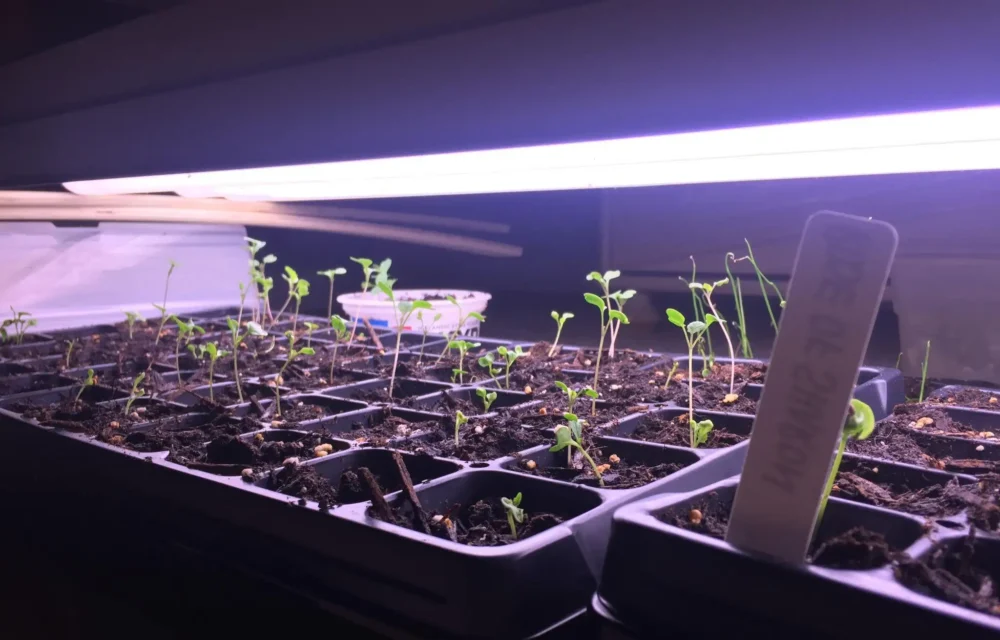
The practical rule keeps it simple: give everything 14–16 hours, because the demanding crops do fine on that schedule too, and the easy ones just take what they need. If a tomato or pepper seedling is still growing tall and pale at 16 hours, the fix is usually more light getting to it — closer or stronger — not more hours. Pushing the schedule toward 24 hours is the wrong lever, for the reasons above.
What about microgreens?
Microgreens are the closest thing to an exception, because they’re harvested so young that they’re forgiving — and some growers do push them with longer days to deepen color. For most microgreen growers, though, 14–16 hours a day grows them well, on the same rhythm as seedlings.
The practical difference is simply that you have more room to experiment here: if you want to try longer days to push color or yield on microgreens, it’s low-risk. With tomatoes and peppers, don’t bother — the standard schedule already does the job.
How do you keep the schedule going without thinking about it?
Hand-switching a light on and off for six weeks is a losing game — you’ll forget, and an inconsistent schedule does more harm than a slightly imperfect one. Two ways to automate it:
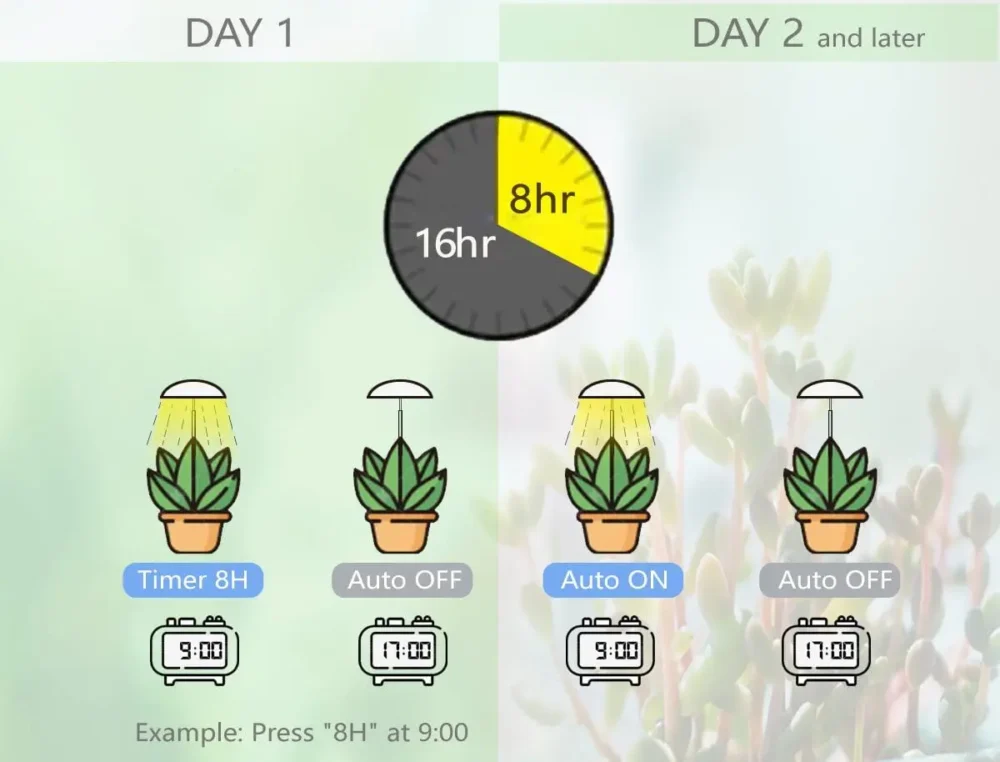
- Light with a built-in timer: set the hours once and it repeats the same on/off cycle daily on its own. Our clip-on grow lights do exactly this — pick a 4, 8, or 12-hour cycle and they repeat it each day, so there’s no outlet timer to buy and nothing to remember.
- Light without a timer: plug it into a basic outlet timer, set your window once (say 6 a.m. to 10 p.m.), and the timer does the rest.
One honest note on built-in timers: they usually offer fixed presets rather than any duration you choose — ours give 4, 8, or 12 hours — and they repeat the same cycle daily. For a small shelf or a single plant, that’s genuinely set-and-forget. If a crop wants a longer day than the presets reach — say the full 16 hours this guide recommends for seedlings — use a basic outlet timer that lets you set any on/off window. Pick whichever actually hits your schedule.
Either way, start the schedule when the first sprouts appear, choose one window, and then stop adjusting it. Consistency day to day is what seedlings reward — far more than an occasional “extra” hour.
One last thing worth knowing: if your seedlings stretch tall and pale on the right schedule, it’s usually not your clock — it’s that not enough light is physically reaching the plant. That’s a distance or intensity problem, not an hours problem, and it’s covered properly in the grow light distance guide. Set the schedule, then trust the routine.