
If your fiddle leaf fig is dropping leaves, your monstera is stretching toward the window, or your herbs keep dying on the kitchen counter, there’s a good chance the problem isn’t your “black thumb” – it’s your light.
And not just how much light… but what color grow light is best for indoor plants.
You’ve probably seen it all by now:
Harsh purple grow lights that turn your living room into a nightclub
“Daylight” bulbs labeled 5000K or 6500K that look bright—but do they actually grow plants?
Sleek full spectrum grow lights promising “natural sunlight” in a strip
And somehow… your plants still look stretched, pale, or just “okay.”
So what’s actually going on?
But which grow light color spectrum actually helps your houseplants thrive—not just survive?
If you’ve ever asked what color grow light is best for indoor plants, you’re already ahead of most plant owners. Yes, color (spectrum) matters a lot—especially in low-light homes where windows aren’t doing much of the work.
Your room might look bright —but your plants could still be starving.
Indoor plants don’t just need light. They need the right spectrum.
In low-light spaces, warm or decorative bulbs often lack the blue and red wavelengths plants rely on.
The result?
Stretching, leggy growth
Poor or no flowering
Yellow, lifeless leaves
The best light spectrum for indoor plants should support growth and look natural in your space.
Purple (red + blue) grow lights: highly efficient for photosynthesis, but harsh on the eyes and distort plant colors
Full spectrum LED grow lights: closer to natural daylight, show true leaf color, and fit seamlessly into home environments
That’s why full spectrum lighting is now the preferred choice for most indoor setups. It provides:
Strong, compact growth
Healthier color and more reliable flowering
A space that still feels like a home — not a lab
Relying on “any bright lamp” is one of the biggest indoor gardening mistakes I see. Here’s when that approach fails:
If your plants are stretching, not blooming, or losing color, it’s usually not just “low light”; it’s the wrong light color. Choosing a high-quality full spectrum LED grow light for houseplants solves that by giving your plants the right spectrum, intensity, and coverage from day one.
Plants don’t “see” light like we do.
We care about brightness and color. Plants care about:
That’s why the best light spectrum for indoor plants is not always the same light that looks nicest to our eyes.
When you’re choosing the best LED grow light for houseplants, these two terms matter way more than “wattage”:
| Term | What it means | Why it matters |
|---|---|---|
| PAR (Photosynthetically Active Radiation) | The slice of light spectrum plants use for photosynthesis (400–700 nm) | Tells you which colors of light actually feed the plant |
| PPFD (Photosynthetic Photon Flux Density) | How many PAR photons hit 1 m² per second (µmol/m²/s) | Tells you how much usable light your plant is getting |
Typical indoor PPFD targets:
Chlorophyll (the green stuff in leaves) doesn’t absorb all colors equally. It mainly uses:
That’s why blue light for vegetative growth and red light for flowering plants are always mentioned in grow light guides.
Blue is your “compact, leafy growth” color. Under enough blue:
Perfect for:
Red is your “flower and stretch control” color. Adequate red:
Great for:
The red blue ratio for plants changes with the goal: more blue for compact foliage, more red for blooms and fruit.
Green and yellow often get ignored, but indoors they matter:
That’s a big reason I prefer full spectrum LED grow lights for home over harsh purple.
Far-red (around 700–750 nm):
In a small apartment, too much far-red + weak blue can mean tall, floppy, weak plants.
Good fixtures keep far-red controlled, not dominant.
A full spectrum, sunlight-like white grow light with strong blue + red, and some green/yellow/far-red for balance.
For a typical indoor mix (pothos, monstera, succulents, herbs, maybe a flowering plant), the most practical answer to what color grow light is best for indoor plants is:
A full spectrum, sunlight-like white grow light with strong blue + red, and some green/yellow/far-red for balance.
Look for:
If you want an easy indoor setup, I’d use a high-CRI full spectrum panel or bar over a small plant corner. For flexible positioning on desks or shelves, adjustable gooseneck indoor plant grow lights make it simple to dial in distance and angle without complicating your space.
When people ask what color grow light is best for indoor plants, they’re really asking about spectrum. Different spectrums hit different plant needs and affect how your room looks.
“Grow light color spectrum” = which wavelengths (colors) the LED produces.
In practice, spectrum choices fall into a few simple groups.
Blurple = heavy blue + red mix, usually purple to your eyes.
Pros:
Cons:
I used blurple fixtures in test racks for pure efficiency, but I don’t recommend them for living rooms anymore.
Purple (blurple) lights:
White full spectrum lights:
For most home growers, white full spectrum LEDs win.
Full spectrum LED grow lights are built to mimic natural daylight with a balance of blue, green, red, and some far‑red.
If you want one “do‑everything” grow light color for houseplants, full spectrum white is the sweet spot.
Full Spectrum (white):
Red/Blue (blurple):
For normal homes and apartments, I always suggest full spectrum white LEDs for indoor plants.
Kelvin (K) is how “warm” or “cool” the white looks:
3000K–4000K (warm white):
5000K–6500K (cool/daylight white):
Both can grow plants if spectrum is complete. Think of Kelvin as vibe + slight emphasis, not a growth-only metric.
If you’re choosing between 5000K and 6500K grow lights:
5000K:
6500K:
For a single light above foliage houseplants, 5000K–5500K is usually the best compromise.
| Goal / Setup | Best Grow Light Color / Spectrum |
|---|---|
| Mixed houseplants in living room | Full spectrum white, 4000–5000K |
| Seedlings, herbs, leafy greens | Full spectrum, 5000–6500K, strong blue |
| Flowering or fruiting focus | Full spectrum with extra red, 3000–4000K |
| Hidden grow tent, max efficiency | Red/blue blurple or full spectrum panel |
| Small apartment, aesthetic + growth | High‑CRI full spectrum daylight LED |
If you’re unsure, pick a high‑CRI full spectrum white LED around 5000K—it’s the most forgiving and the most practical answer to “what color grow light is best for indoor plants” in real homes.
When people ask “what color grow light is best for indoor plants,” they’re usually choosing between blurple red/blue LEDs and full spectrum white LEDs. Both can grow plants, but they work very differently in real homes.
Pros (red/blue “blurple” grow lights):
Cons:
Pros (full spectrum / daylight-style white LEDs):
Cons:
Go full spectrum white when:
For pro‑level crops where quality and visual checks matter (like cannabis or high‑value ornamentals), I’d always lean toward high‑CRI full spectrum fixtures, similar to dedicated full spectrum indoor grow lights for cannabis offered in pro ranges.
Red/blue blurple still works well when:
In these cases, blurple can be a cost‑effective tool, especially if you dial in distance, PPFD, and timing.
If you stick with red/blue:
Most casual indoor gardeners do best with a balanced or daylight-like spectrum instead of obsessing over a precise red:blue ratio.
Blurple lights, with very low CRI, hide detail and make everything look purple – fine in a utility grow room, not great in a stylish home.
For foliage houseplants, the best light spectrum for indoor plants is a full spectrum, daylight-style white in the 5000K–6500K range.
Why:
If you’re outfitting a plant corner with mixed foliage, I’d use a high-CRI full spectrum LED grow light so leaves look true-to-color and it doubles as room lighting.
“Low light” plants (zz plant, snake plant, peace lily) still need decent intensity, just not as much as sun-lovers. For these:
Tropical houseplants (philodendron, calathea, anthurium, alocasia) perform best under a balanced, sunlight-like spectrum:
Succulents and cacti love bright, cool daylight:
If succulents are getting leggy, it’s usually a lack of intensity, not the wrong Kelvin. But staying in the “cool daylight” range gives you the right spectrum for tight, colorful growth.
For flowering plants (orchids, African violets, hoya, begonias):
You don’t need pure red/blue blurple. A warm-to-neutral full spectrum gives you blooms and still looks good in your home.
For indoor herb gardens (basil, mint, parsley, lettuce, spinach):
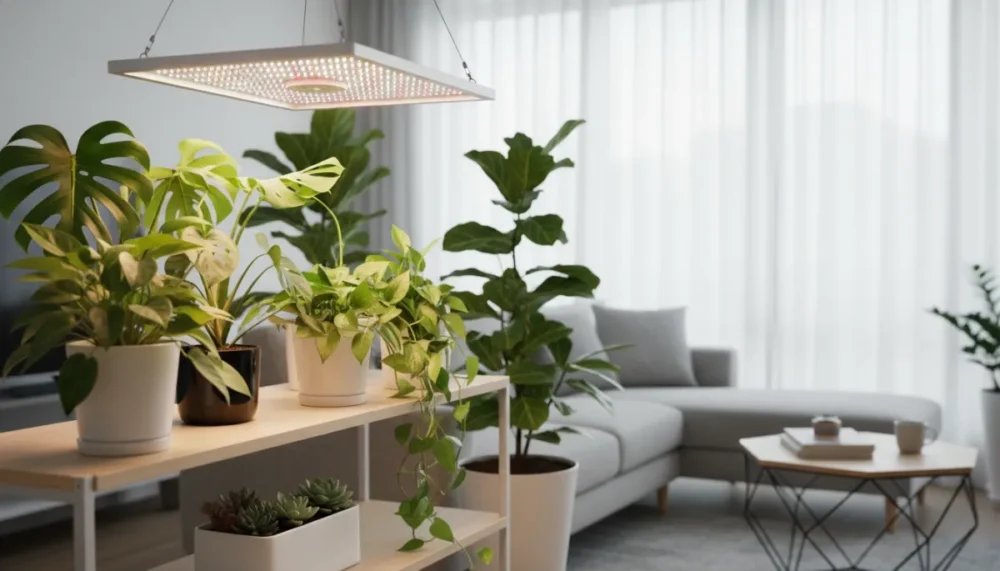
If you’ve got a mix of succulents, foliage, herbs, and a few bloomers under one fixture, the most practical choice is:
This “middle ground” spectrum won’t be “perfect” for every species, but it’s the best all-around grow light color for indoor plants when you’re lighting different types together in one small apartment or plant shelf.