
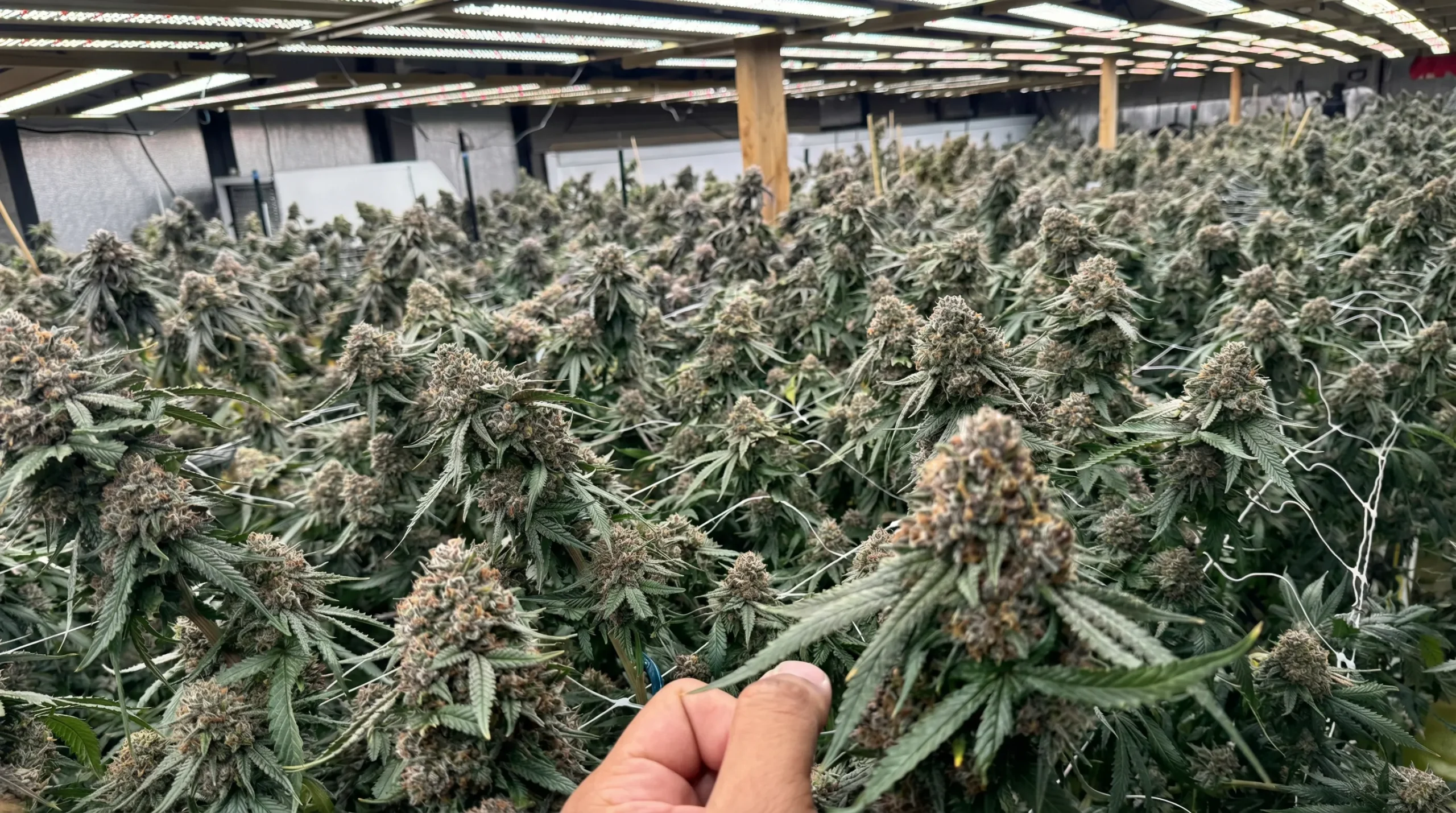
Understanding Cannabis Light Requirements
Indoor cannabis lives or dies by light. If you get the light wrong, no nutrient, additive, or “secret trick” will fix it. I design my grow setups around lighting first, everything else second.
Why Cannabis Needs Strong Light (Photosynthesis Basics)
Cannabis is a high‑energy crop. Light is the fuel that powers:
- Photosynthesis – light + CO₂ + water → sugars (growth, yield, resin)
- Root and stem development – stronger structure, tighter internodes
- Bud production – more light = more biomass and cannabinoids (up to a point)
Weak light = stretchy plants, airy buds, low THC. Strong, controlled light = dense, heavy, high‑quality flowers.
Key Grow Light Metrics (PAR, PPFD, PPF, DLI, Efficacy)
Forget “wattage only” – serious cannabis lighting is measured in photons, not just power draw.
| Metric | What It Means (Simple) | Why It Matters for Cannabis |
|---|---|---|
| PAR | Photosynthetically Active Radiation (400–700 nm) | The light range your plants actually use to grow |
| PPFD | Photosynthetic Photon Flux Density (µmol/m²/s) | Light intensity hitting 1 m² of canopy |
| PPF | Photosynthetic Photon Flux (µmol/s) | Total usable photons a light emits per second |
| DLI | Daily Light Integral (mol/m²/day) | Total light your plants get per day |
| Efficacy | µmol/J (micromoles per joule) | How efficiently a light turns power into photons |
For high‑yield cannabis lighting, I aim for high PPFD and efficacy ≥ 2.5 µmol/J with modern full spectrum LED grow lights.
Ideal Light Intensity by Growth Stage
Cannabis doesn’t need the same intensity at every stage. Push too hard early and you’ll stunt or burn plants; too weak in flower and you lose yield.
Target PPFD Ranges (LED grow lights, no added CO₂):
| Stage | PPFD Range (µmol/m²/s) | Notes |
|---|---|---|
| Seedlings / Clones | 100–300 | Gentle light, higher distance, avoid stretching |
| Vegetative | 300–600 | Fast growth, tight nodes, strong structure |
| Early Flower | 600–800 | Transition period, avoid sudden jumps in intensity |
| Mid–Late Flower | 800–1000 (up to 1200 with CO₂) | Maximize yield and resin, watch for light stress |
Use a dimmable LED grow light so you can keep the same fixture and just adjust power instead of constantly raising/lowering the lamp.
Photoperiod Rules: 18/6 vs 12/12
Cannabis (photoperiod strains) use day length to decide when to grow and when to bloom.
- Vegetative (18/6 or 20/4)
- 18 hours on / 6 off is the standard.
- Keeps plants in veg, builds size and structure.
- More hours = more DLI, but also more power cost.
- Flowering (12/12)
- 12 hours on / 12 off triggers and maintains flowering.
- Dark period must be 100% uninterrupted – light leaks cause herms, reveg, or stress.
For most indoor cannabis grows, my baseline schedule is:
- Veg: 18/6 under moderate PPFD
- Flower: 12/12 under high PPFD with full spectrum grow lights
Nail these light requirements, and every other part of your grow gets easier.
Types of Grow Lights for Cannabis
When I pick grow lights for cannabis, I only care about three things: yield, efficiency, and heat control. Here’s how the main options stack up.
LED Grow Lights for Cannabis (Pros & Cons)
Modern LED grow lights for cannabis are what I recommend to most growers, from small tents to pro rooms.
Pros:
- High efficiency – More grams per watt, lower power bills.
- Less heat – Easier to manage temps in grow tents and small rooms.
- Full spectrum – Good LED grow lights cover veg + flower with one fixture.
- Dimmable – Easy to dial in PPFD for seedlings, veg, and flowering.
- Long lifespan – Quality diodes and drivers run for years.
Cons:
- Higher upfront cost than cheap HID or CFL.
- Lots of fake specs – Many “1000W” panels are actually 100–150W. You need real PPFD maps and μmol/J data.
For best LED grow lights for cannabis, I look for:
- ≥ 2.5 μmol/J efficacy
- Branded diodes (Samsung, Osram, etc.)
- Reliable drivers (Mean Well–level quality)
- True power draw and real coverage area listed
HID Grow Lights: HPS, MH, CMH/LEC
HID grow lights for marijuana still work well, but they run hot and burn more power.
- HPS (High Pressure Sodium)
- Great for flowering, strong red/orange spectrum
- Good yields but high heat and power usage
- MH (Metal Halide)
- Blue-heavy spectrum, better for veg
- Usually swapped to HPS for flower
- CMH / LEC (Ceramic Metal Halide)
- More balanced spectrum, better quality flower than old HPS setups
- Still more heat and less efficient than top LEDs
HID can be cheap to start, but in most global markets, electricity costs kill the value long term.
Fluorescent and CFL Grow Lights
I only use fluorescent grow lights and CFLs for light-duty tasks:
Good for:
- Seedlings and clones
- Very small grows (micro cabinets, propagation shelves)
- Gentle light where you don’t want to burn young plants
Limits:
- Weak PPFD for cannabis flowering
- Poor canopy penetration
- Not ideal for full-cycle high-yield grows
They’re simple, but if you want dense buds, you outgrow them fast.
LED vs HID vs Fluorescent – Quick Comparison
| Type | Yield Potential | Cost to Run | Heat Output | Efficiency (μmol/J) |
|---|---|---|---|---|
| LED grow lights | High (best overall) | Low | Low–Medium | 2.2–3.5+ |
| HID (HPS/MH/CMH) | High but power-hungry | Medium–High | High | ~1.0–1.7 |
| Fluorescent / CFL | Low–Medium | Medium | Low | ~0.6–1.0 |
For most indoor cannabis growers today, especially in global markets with rising power prices and smaller spaces, full spectrum LED grow lights are simply the smartest move: more yield per watt, better control, and easier heat management.
Cannabis light spectrum explained
When you’re choosing grow lights for cannabis, spectrum matters just as much as intensity. Different colors in the spectrum trigger different responses in the plant, from tight veg growth to stacked flowers and boosted terpenes.
Full spectrum grow lights vs targeted spectrum
- Full spectrum grow lights (modern white LEDs) imitate natural sunlight.
- Good for: seedling → veg → flower under one light
- More natural growth, better color, easier to read plant health
- Targeted spectrum lights (old blurple LEDs, some HPS/MH mixes) push specific bands only.
- Can work, but usually mean:
- Weaker performance in some stages
- Poor visibility (harder to diagnose issues)
- Can work, but usually mean:
For most home and tent setups, full spectrum grow lights for cannabis are simply more practical and more forgiving.
Blue light for vegetative growth
Blue-heavy light (around 400–500 nm):
- Keeps plants short, compact, and bushy
- Builds thicker stems and strong branches
- Reduces stretching in the vegetative stage
If you want tight internodes and sturdy plants, make sure your vegetative stage grow lights have solid blue output.
Red and far-red for flowering and dense buds
Red and far-red (about 600–750 nm):
- Red light drives flower development and yield
- Helps build dense buds and fuller colas
- Far-red affects shade response and flowering speed (can help “finish” faster when used correctly)
This is why LED vs HPS grow lights is a real discussion: HPS throws a ton of red, which flowers well, but a good full spectrum LED grow light balances red with other bands for better quality and efficiency.
UV and IR light for trichomes and potency
Handled carefully, UV and IR can help push quality:
- UV (UV-A mainly)
- Can boost trichome production
- May increase terpenes and cannabinoids
- Must be used lightly to avoid stress or burn
- IR (infrared heat)
- Gently warms leaves and can influence flower density
- Too much = heat stress, so good heat management under grow lights is key
Used as supplemental grow lights for cannabis, UV/IR bars can give that extra edge on resin and nose, especially for top-shelf runs.
Why full spectrum LED grow lights work best for most growers
For most Global growers running tents or small rooms, full spectrum LED grow lights for cannabis hit the sweet spot:
- One light from seed to harvest – no swapping fixtures
- High efficacy (μmol/J) – more usable light per watt, lower bills
- Less heat vs HID – easier climate control in small spaces
- Balanced cannabis light spectrum – blue for veg, red for flower, plus some added bands for resin
If you’re asking “do grow lights work as well as the sun?” – with a quality full spectrum LED grow light tuned for PAR and PPFD for marijuana growing, the answer is yes. For indoor setups, they’re the most reliable, energy-efficient choice for high-yield cannabis lighting right now.
How to Choose the Best Grow Lights for Cannabis
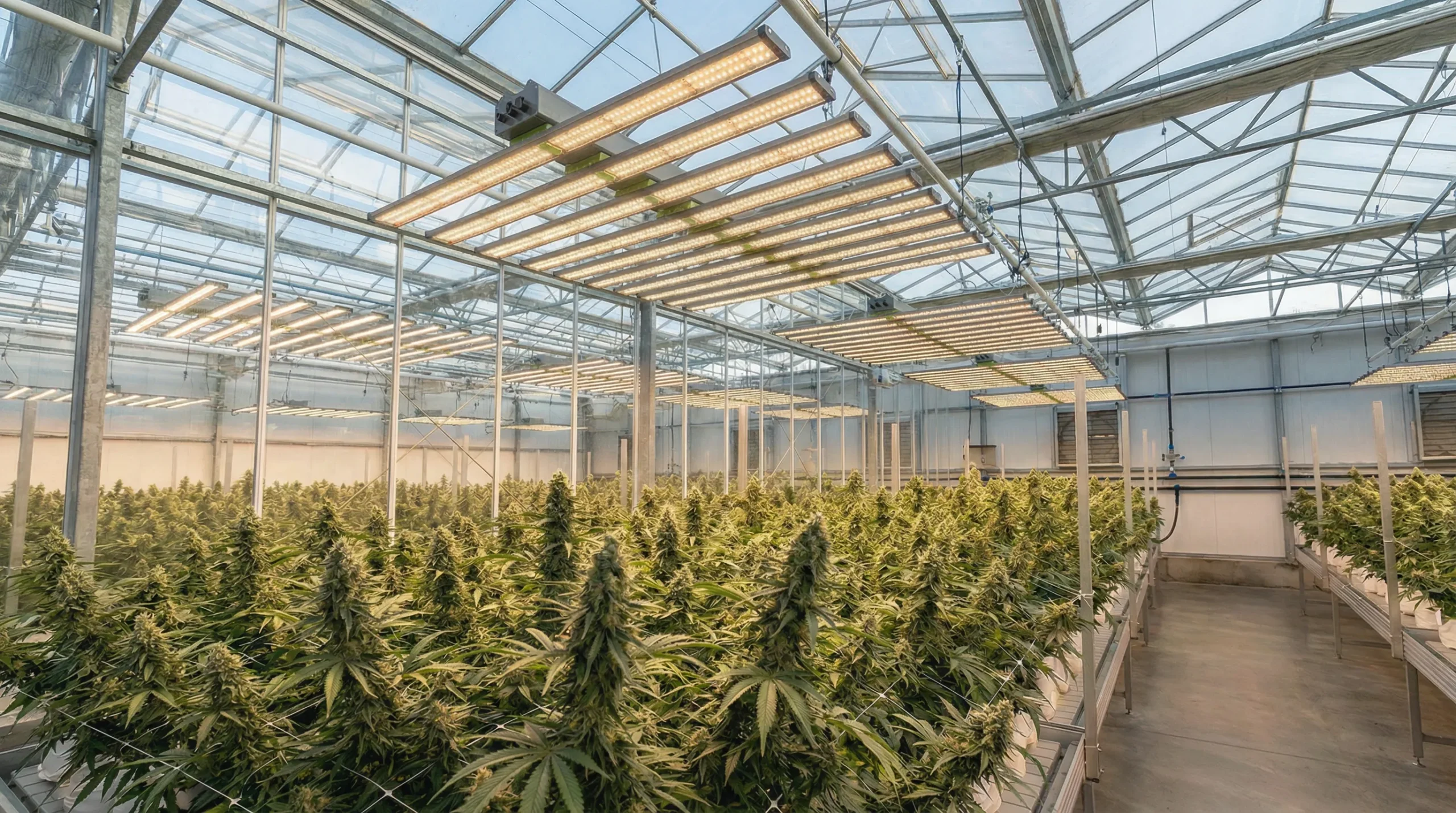
Match grow lights to your grow space
When I choose grow lights for cannabis, I start with the tent or room size:
| Grow Space (tent) | Area (sq ft) | LED Power (true watts) | Notes |
|---|---|---|---|
| 2×2 ft | 4 | 120–180 W | 1–2 plants, small LED |
| 2×4 ft | 8 | 240–320 W | Slim bar LED ideal |
| 3×3 ft | 9 | 300–400 W | Good for 2–4 plants |
| 4×4 ft | 16 | 480–650 W | Standard home grow |
| 5×5 ft | 25 | 750–1000 W | Needs strong bars |
- Always look at actual power draw, not “HPS equivalent”.
- Plan 1 strong LED per tent instead of lots of weak ones.
Coverage area & hanging height
Good cannabis grow lights must cover the whole canopy evenly:
- Seedlings: hang 24–30 in (60–75 cm) above the canopy, dimmed.
- Veg: 18–24 in (45–60 cm), medium power.
- Flower: 12–18 in (30–45 cm), higher power if plants can handle it.
Check the manufacturer’s PPFD map:
- Aim for ~400–600 μmol/m²/s in veg.
- Aim for ~700–900 μmol/m²/s in flower (without added CO₂).
Recommended wattage per square foot
For energy efficient grow lights for weed, I stick to this:
| Stage | LED Watts per sq ft (modern LEDs) |
|---|---|
| Low demand / budget | 25–30 W |
| Standard home grow | 30–40 W |
| High-yield, dialed in | 40–45 W |
- Higher efficiency LEDs (≥2.7 μmol/J) can hit big yields with less wattage.
- Don’t chase “more watts”; chase better PPFD and efficiency.
Must-have features on LED grow lights for cannabis
When I design or choose best LED grow lights for cannabis, these are non‑negotiable:
- Dimmable: knob or controller to dial PPFD for each stage.
- Waterproof rating: at least IP65 for tents with humidity.
- High-efficacy diodes: Samsung, Osram, Bridgelux, or equivalent.
- Quality drivers: Mean Well, Inventronics, or proven in-house drivers.
- Even bar layout: better spread, less hot spots than old “blurple” panels.
- Passive cooling: big heat sinks, no cheap noisy fans.
How to avoid bad grow lights & fake specs
There’s a lot of junk in the cannabis grow light comparison space. I filter fast:
- Ignore “blurple” lights with no proper PAR/PPFD maps.
- Be careful with Amazon-only brands with 5 different model names and identical housings.
- Watch for fake specs:
- “1000 W” in title but draws 100 W at the wall.
- No μmol/J or PPFD data.
- No real warranty or local service.
Quick checklist before I buy:
- Do they publish PAR, PPFD, PPF clearly?
- Is there a real 3–5 year warranty?
- Are there user grows showing dry yield per light?
If a light can’t answer those, I don’t hang it over my cannabis.
Best Grow Lights for Cannabis Setups
When I choose grow lights for cannabis, I always match the light to the grow space, budget, and yield goals. Here’s how I break it down.
Best LED Grow Lights for Small, Medium, and Large Grows
Small grows (1–4 plants / 2×2–3×3 ft tents)
- Look for 100–240W full spectrum grow lights
- Target PPFD for cannabis around 500–800 µmol/m²/s in flower
- Thin, fanless LED boards are ideal to control heat in tight spaces
Medium grows (4–8 plants / 3×3–4×4 ft tents)
- Go for 240–480W LED grow lights for cannabis
- Focus on high efficacy (≥2.5 µmol/J) to keep power costs low
- Uniform coverage edges-to-center is key for high yield cannabis lighting
Large grows (5×5 ft tents, rooms, multi-light setups)
- Use 600–1000W LED grow lights or multiple bar-style fixtures
- Aim for strong, even PPFD for cannabis plants across the full canopy
- Dimmable and linkable lights matter a lot for big rooms and vertical racks
Budget vs Premium Cannabis Grow Light Options
Budget lights (entry-level home growers)
- Good for: 1–4 plants, personal stash
- Look for:
- Basic full spectrum grow lights
- Dimmable LED grow lights with real PPFD charts
- Solid warranty (at least 2–3 years)
Premium lights (serious home and pro grows)
- Good for: higher yields, better resin, long-term use
- Look for:
- Top-bin diodes (Samsung, Osram, etc.)
- High efficacy (2.7–3.0+ µmol/J)
- Deep canopy penetration and strong red spectrum for flower
- Strong warranty and local/global support
Factory-Direct and Pro-Grade LED (iLEDGLOW Style)
I run a lot of factory-direct, pro-grade LEDs under the iLEDGLOW-style model because it hits what global growers actually need:
Direct from grow lights factory = no middleman markup
Customized indoor cannabis lighting setup for different tent sizes
Waterproof, dimmable, and driver separated for cooler operation
Designed specifically as energy efficient grow lights for weed with full, balanced spectrum
This kind of factory-direct approach gives home growers and small commercial rooms pro-level performance without inflated branding costs.
Our Pro Series is built around ≥2.5 μmol/J, branded diodes, and reliable drivers → Cannabis Grow Lights
Real Grow Results: Yield and Feedback
From my own setups and user feedback across different regions:
- Small 2×2 ft tent with a 150–200W LED
- 2–4 plants, average 80–150 g dry per harvest with basic training
- 4×4 ft tent with a 400–480W high efficacy LED
- 4–6 plants, 400–600 g dry is realistic with dialed environment
- 5×5 ft with 600–800W bar-style LED
- 6–9 plants, 600–900 g+ possible for experienced growers
Most growers switching from HPS to LED grow lights for cannabis report:
- Lower heat, easier climate control
- Lower power usage at the same or better yields
- Better terpenes and trichomes thanks to improved spectrum and less heat stress
If you’re picking grow lights for cannabis today, I’d always start with a well-built, full spectrum LED sized correctly for your tent, then move up to pro-grade, factory-direct models like iLEDGLOW when you’re ready to push yields and efficiency.
Grow light setup for indoor cannabis
Dialing in your grow lights for cannabis is what separates “plants survived” from “tents packed with sticky buds.” Here’s how I set lights for a stable, high‑yield indoor grow.
How high to hang grow lights in each stage
Exact height depends on the fixture, but this works well for most full spectrum grow lights and best LED grow lights for cannabis:
- Seedlings / clones
- Height: 24–30 in (60–75 cm) above canopy
- Dimmer: 25–40% power
- Goal: gentle, even light to avoid stretching or burning.
- Vegetative stage
- Height: 18–24 in (45–60 cm)
- Dimmer: 50–70% power
- Aim for PPFD ~400–600 μmol/m²/s for compact, strong growth.
- Flowering stage
- Height: 12–18 in (30–45 cm) for most modern LEDs
- Dimmer: 70–100% power
- Aim for PPFD ~700–1000 μmol/m²/s for high‑yield cannabis lighting.
- If tips fade or leaves claw, raise the light or dim it.
Always adjust by watching the plants:
- Leaves praying up = usually perfect
- Leaves canoeing, bleaching, or curling = too much light
- Stretchy, weak stems = not enough light
Light schedules and smooth stage transitions
For indoor cannabis lighting setup, I keep the schedule simple:
- Seedling / veg photoperiod: 18/6 (18 hours on, 6 off)
- Flowering: 12/12 (12 on, 12 off) to trigger budding
- Autos: Keep 18/6 or 20/4 from seed to harvest; they don’t need 12/12.
When switching stages:
- Drop from 18/6 to 12/12 overnight, but
- Ramp intensity over 3–7 days (e.g., +10–15% power every couple days)
- Keep “lights off” time 100% dark – no light leaks in your grow tent.
Managing heat, airflow, and power usage
Strong LED vs HPS grow lights behave differently, but the rules are the same:
- Heat control
- Use an exhaust fan at the top of the tent to remove hot air.
- Keep canopy temps roughly 24–28°C (75–82°F) with LEDs; HPS usually needs the cooler end of that range.
- If your hand feels uncomfortably hot at canopy height after 30 seconds, the lights are too close or too strong.
- Airflow
- Clip fans blowing across the canopy, not directly blasting leaves.
- Aim for gentle movement to prevent hot spots, mold, and weak stems.
- Power usage
- Run lights during off‑peak hours if power is expensive locally.
- Use dimmable LED grow lights for tents – you don’t need max power in early veg.
- Match actual watt draw to tent size (rough guide for LEDs):
- 2×2 ft: 100–150 W
- 2×4 ft: 200–300 W
- 4×4 ft: 400–500 W
- 5×5 ft: 600–750 W
Side lighting and supplemental lights
If you want better canopy penetration and more developed lower buds:
- Add side bars or small LED panels on the tent walls, slightly above mid‑canopy.
- Keep side lights dimmed so you’re not blasting the sides of the leaves.
- Great spots for:
- Dense scrogs where the top blocks light
- Tall strains that create a thick top layer
- Avoid cheap, purple “burple” panels – go for full spectrum supplemental lights with decent efficacy.
Set up your indoor marijuana grow room lighting this way, and you’ll keep plants in the safe zone: no light burn, no stretching, stable temps, and buds getting light from top and sides.
Cannabis Grow Light Problems: Bleaching, Light Stress, and Stretching (Quick Leaf Checklist)
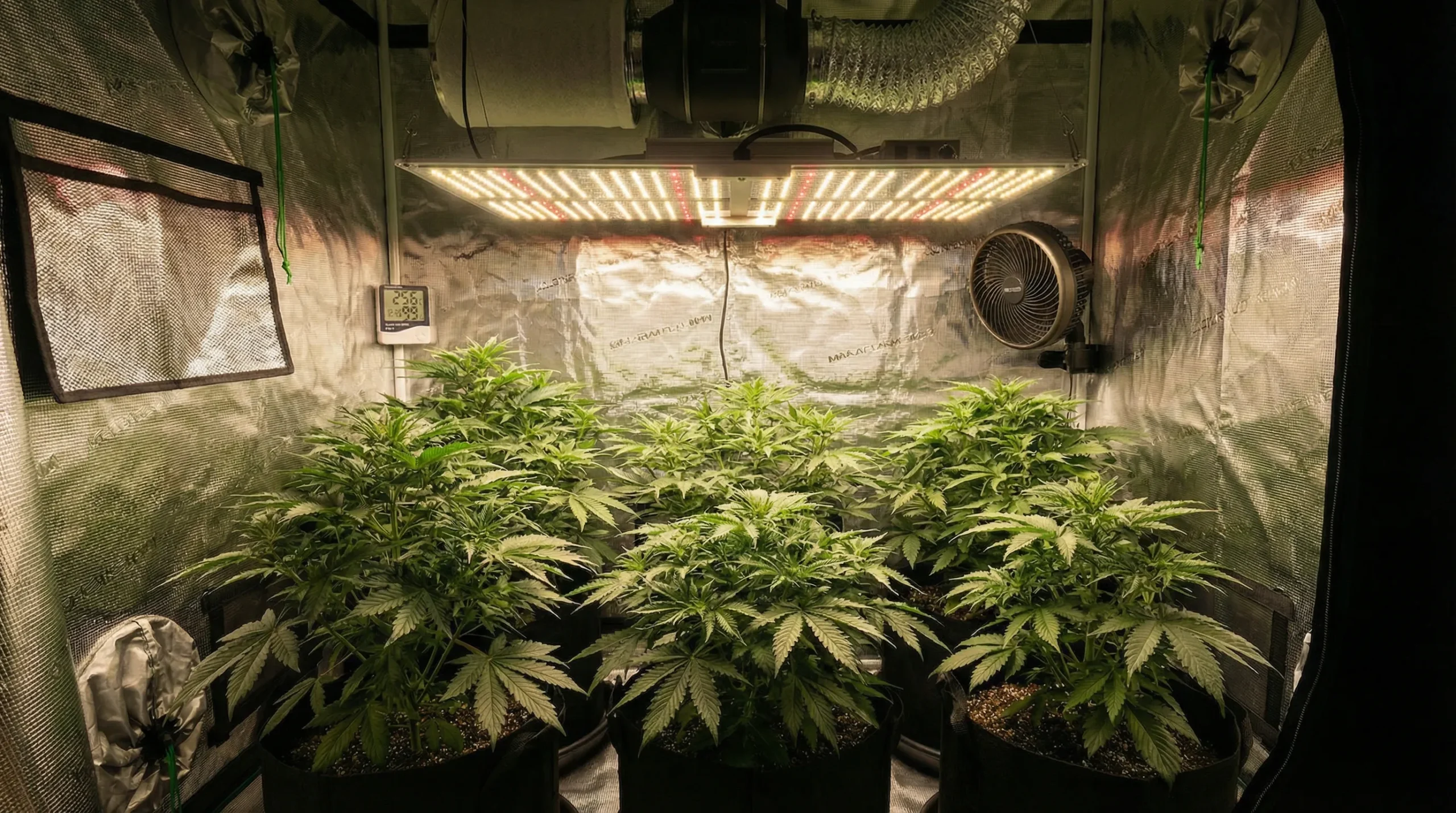
Signs of Light Stress on Cannabis
When grow lights for cannabis are off, take a close look at the leaves:
- Light bleaching
- Top buds turn pale yellow or white
- Sugar leaves fade while lower leaves stay green
- Often caused by LED grow lights hung too close
- Light stress
- Leaves canoe/taco up, edges curl or crisp
- Very flat leaves pointing straight at the light
- New growth looks twisted or “angry”
- Stretching from low light
- Long gaps between nodes
- Thin, weak stems that flop over
- Plants chasing the light, leaning hard toward the fixture
If you see any of these, your cannabis lighting setup needs a quick reset.
Fixing Too Much vs Too Little Light
Too much light / too high PPFD for cannabis:
- Raise the light 10–30 cm / 4–12 in
- Dim LED grow lights instead of moving them if height is limited
- Drop PPFD for cannabis to safer ranges:
- Veg: 400–700 μmol/m²/s
- Flower: 700–1000 μmol/m²/s (higher only with CO₂)
- Shorten distance for side lighting slowly and watch the tops
Too little light / weak intensity:
- Lower the light closer (in small steps over a few days)
- Add a second light or supplemental bars to fill dark corners
- Keep good baseline targets:
- 30–40W LED per sq ft (good full spectrum grow lights)
- Rotate plants so all sides see strong, even PPFD
Heat Issues and Light Burn
High-powered LED grow lights for cannabis still create heat, just more at the driver and heatsinks than at the bulb.
Signs of heat stress / light burn:
- Leaves feel crisp or dry but not fully bleached
- Edges brown or curl up
- Tops are hot to the touch compared to the lower canopy
How to fix it:
- Keep good airflow:
- Oscillating fans across the canopy
- Inline fan + carbon filter to pull hot air out of the tent
- Keep temps around:
- 24–28°C (75–82°F) lights on for most indoor cannabis grows
- Move drivers outside the tent when possible
- Avoid combining high PPFD + high temps + low humidity, that’s the perfect storm for light burn
Maintenance Tips for Cannabis Grow Lights
If you want the best LED grow lights for cannabis to last and keep putting out strong PAR and PPFD, treat them like core equipment, not disposable gear:
- Clean lenses and bars
- Wipe dust from diodes and reflectors with a soft, dry cloth
- Dust kills output and PAR over time
- Check all connections
- Make sure power plugs, dimmers, and drivers are tight
- No exposed wires or sketchy extension cords
- Run drivers cool
- Keep drivers away from direct heat and humidity
- Good ventilation extends LED lifespan and keeps PPFD stable
- Inspect coverage
- Make sure the full grow tent lighting layout is even
- No big hot spots or dead corners over the canopy
If I build or choose a light for growing marijuana, I assume it’ll be used hard: long hours, warm rooms, and tight tents. So I design and recommend dimmable LED grow lights for tents with reliable drivers, real efficacy numbers, and solid thermal management. That keeps your cannabis plants safe from light issues while giving you the intensity you need for high-yield indoor cannabis lighting.
Advanced cannabis lighting tips
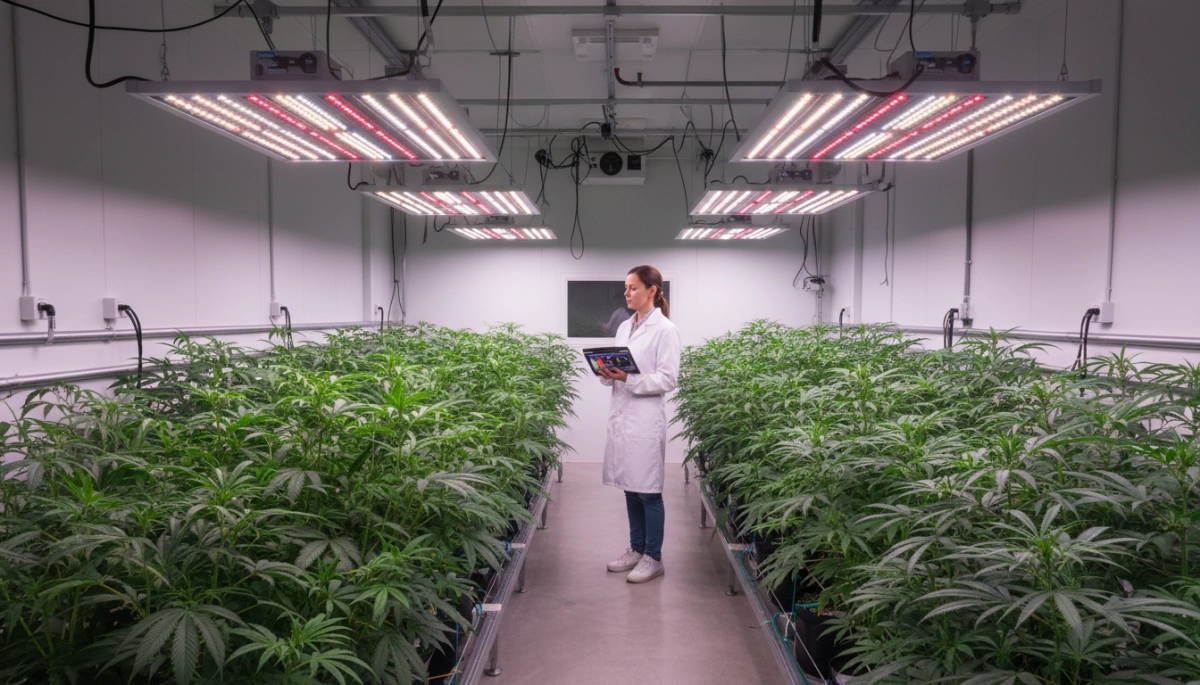
Spectrum tuning for different strains
When I build grow lights for cannabis, I don’t chase gimmicks—I tune spectrum for results:
- More blue (420–500 nm)
- Tighter internodes, less stretch
- Great for sativa-leaning strains, veg-heavy grows, and mothers
- More red (600–680 nm)
- Better flower density and yield
- Ideal for indica-dominant and commercial flowering rooms
- Touch of far-red (730 nm)
- Faster “lights off” signal, helps control stretch at flip
- Can shorten transition time from veg to bloom
If your full spectrum grow lights are dimmable and spectrum-tunable, you can:
- Run cooler, bluer spectrum in veg
- Shift to warmer, red-heavy spectrum in flower
- Add far-red only in short bursts to avoid uncontrolled stretching
Running high PPFD with CO₂
High-yield cannabis lighting is all about matching PPFD, CO₂, and environment:
- Target PPFD with LEDs
- Veg: 400–700 μmol/m²/s
- Flower (standard): 700–900 μmol/m²/s
- Flower (CO₂ enriched): 900–1200+ μmol/m²/s
- To push PPFD above ~900 μmol/m²/s safely, you need:
- CO₂ at 900–1200 ppm
- Temps 26–29°C (78–84°F) with lights on
- Strong airflow and stable VPD
Our energy-efficient LED grow lights for weed are built to handle high PPFD while keeping heat manageable, so you can push yields without cooking the room.
UV and far-red for resin and flowers
Used right, UV and IR/far-red are tools, not gimmicks:
- UV (mainly UV-A 365–400 nm)
- Can boost trichomes, terpenes, and potency
- Run at low intensity and short windows (e.g., last 2–3 weeks of flower, 1–3 hours per day)
- Far-red / IR
- Helps with flower development and canopy penetration when blended correctly
- Short “end-of-day” far-red pulses can help plants transition to “night” faster
I design UV and far-red on our fixtures so they’re supplemental, not overpowering—you want stress that boosts resin, not damage that kills yield.
New trends in cannabis grow lights and tech
Global growers are pushing hard toward smarter, more efficient setups. Key trends I’m building into our best LED grow lights for cannabis:
- High-efficacy diodes (3.0+ μmol/J) to cut power bills
- Slim, bar-style fixtures for even PPFD across the entire grow tent lighting layout
- Onboard dimming + app or controller integration for fine-tuning each stage
- Modular designs so you can scale from 2–4 plants to full rooms
- Integrated spectrum channels (cool white, warm white, red, far-red, UV) instead of single “blurple” LEDs
If you’re serious about indoor marijuana grow room lighting, focus on:
- High efficacy
- Even coverage
- Smart control of spectrum + PPFD + environment
That combo is what actually drives high-yield cannabis lighting, not just wattage on the box.
Grow Lights for Cannabis FAQs
Are LED grow lights better than HPS for cannabis?
For most Global home and pro growers, LED grow lights for cannabis are the better long‑term choice:
- Higher efficiency: More usable PAR and PPFD per watt than HPS.
- Less heat: Easier climate control in tents and small rooms.
- Full spectrum: Better balanced light spectrum for veg + flower with one fixture.
- Lower running cost: Power savings + no bulb changes.
HPS still works and can hit high yields, but if you’re starting now, best LED grow lights for cannabis beat HPS in efficiency, lifespan, and overall ease.
How much light do 2–4 cannabis plants really need?
Light needs are about space, not plant count. For a typical indoor cannabis lighting setup:
- LED wattage per square foot (true draw, not “equivalent”):
- Veg: 20–30 W/ft²
- Flower: 30–40 W/ft²
- Common tent examples:
- 2×2 ft (0.6×0.6 m): 120–200 W LED
- 2×4 ft (0.6×1.2 m): 240–320 W LED
- 3×3 ft (0.9×0.9 m): 240–350 W LED
- 4×4 ft (1.2×1.2 m): 400–500 W LED
For 2–4 plants, a quality full spectrum grow light in the 240–320 W range usually covers a 2×4 or 3×3 tent with solid PPFD for flowering.
Best light spectrum for flowering cannabis
For flowering stage cannabis lights, you want:
- Red‑leaning full spectrum:
- Strong red (around 660 nm) for bud size and yield
- Balanced blue to keep plants compact and avoid stretch
- Optional boosts:
- Far‑red (730 nm) for slightly faster flowering and better canopy penetration
- UV (UV‑A) to help push trichomes, terpenes, and potency
In practice, the best LED grow lights for cannabis use a full spectrum with extra red, so you can veg and flower under the same fixture without swapping bulbs.
How long should grow lights be on each day?
Cannabis is photoperiod‑sensitive, so your cannabis photoperiod lighting schedule matters:
- Seedlings / Veg (photoperiod strains):
- 18 hours ON / 6 hours OFF (18/6)
- Some growers run 20/4, but 18/6 is efficient and proven.
- Flowering (photoperiod strains):
- 12 hours ON / 12 hours OFF (12/12)
- Dark period must be 100% light‑tight.
- Autoflower strains:
- Can run 18/6 from seed to harvest
- Some growers use 20/4 for maximum DLI and PPFD, but power use increases.
Stick to a consistent timer and avoid light leaks to keep your plants stable and flowering on schedule.